Updates

  1. Person pages list letters, writing, profiles and links as sortable tables with filters, and show each person's companies as links; Fund letters show each letter's description in its own column.
  2. Experts show a checked job title and a short description of each person; 30 more people have photographs.
  3. Every company, fund, university and publication the experts work for has a page listing the people there.
  4. Fund letters show each letter's thesis and filter by it; 225 person pages list the essays, columns and newsletter issues the person wrote.
  5. Person pages list every essay and newsletter issue a person wrote, and their own books as a table in List view.
  6. Recommends shows the five largest kinds of book and the rest under More; browse pictures load sooner.
  7. Podcasts and talks link the original episode, filter by Audio and video or Press, and list each publisher once.
  8. Pages are wider, Recommends has List and Grid, and a filter clicked again turns off.
  9. Book cards sit in a ruled grid with Open Library and Goodreads links and each book's one-line note.
  10. Funds is now Investors; each investor's styles are buttons that filter the table.
  11. Podcasts and talks on a person's page filter by year and publisher and show as a list or a grid of pictures.
  12. Quotes show only people's own words: 472 summaries written by list sites are gone.
  13. Country pages open from Browse again, and every link on the shelf lands on a page.
  14. Subject and person pages show their sections as tabs, and each book appears once on a person's page.
  15. Book cards show the quote, who said it and the source; grids show five cards to a row.
  16. On a phone, a menu holds the sections, search, Updates, Feedback and dark mode.
  17. Feedback takes a screenshot of the page with no browser prompt, opens a screenshot full size when you click it, and clears itself once sent.
  18. Book cards are centred, search names the topic each book sits in, and any text cut short shows whole on hover.
  19. Search groups its results by kind: people, companies, geographies, subjects, topics, books, funds, fund letters and papers.
  20. The Books table lists who recommended each book by name, and the browser tab names the section you are in.
  21. Feedback can take a screenshot of the page, or one you paste or choose, and opens in the corner beside Updates.
  22. Each rail button reopens its section where you left it, and Browse, Table and People show on every book and subject page.
  23. Filters grey out choices that hold nothing instead of hiding them, and Books › People filters by authors or recommenders.
  24. Feedback takes a subject line and up to three screenshots.
  25. Biographies are grouped by the person they are about: 41 new pages, from Abraham Lincoln to Lee Kuan Yew.
  26. Sport splits into 23 sports, and Religion into one topic per faith.
  27. Book lists show as cards: the cover, one recommendation quote and every recommender by name.
  28. Seventeen subjects that had two or three pages under different names now have one page each.
  29. Every page lists its Experts as authors and recommenders, with a link to them on the Experts tab.
  30. Economics, Financial history, Financial panics and Accounting are subjects of their own, with one page per financial crisis.
  31. Book, person and subject pages open inside the app, so the tabs stay in view.
  32. 996 more book covers, and photographs or logos for 227 more people and companies.
  33. Books › Browse shows every subject as cards, and the rail holds Fund letters, Papers, Experts, Books and Funds.
  34. Every topic over 150 books splits into narrower topics, each with a page of its own.

Send feedback

What is it?
Screenshots, up to 3 (optional)
or paste one with Ctrl+V

We use your email only to reply to you.

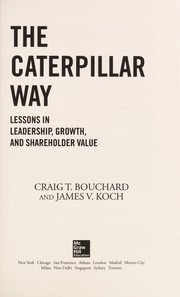
The Caterpillar Way: Lessons in Leadership,

The Caterpillar Way: Lessons in Leadership, Growth, and Shareholder Value

Craig Bouchard, James Koch
2014
T4 361 pages · about 6h 1m to read Open Librarygoodreads

Summary

Bouchard and Koch examine Caterpillar's management and its performance over a long period, focusing on the company's operating discipline and its handling of the extreme cyclicality of construction and mining equipment demand.

The business material covers Caterpillar's dealer network, which is independently owned and is the company's principal competitive asset since parts availability and service response are what customers buy on and what a new entrant cannot replicate; the manufacturing footprint and the Caterpillar Production System; the shift to emerging market demand and the exposure to Chinese construction and to global mining capital expenditure; the financial services arm; and the labour disputes of the 1990s.

The management material centres on the trough planning discipline: because the business is severely cyclical, the company plans its cost structure and its balance sheet against a downturn scenario rather than against a forecast, so that it can operate through a collapse without distress. The authors treat this as the transferable lesson.

The reference has not verified the specific figures and claims in this account, which was written with company cooperation and is favourable throughout. The book was published in 2014, near the peak of the mining capital expenditure cycle, and the years immediately following were difficult for Caterpillar in ways the analysis did not anticipate, which is itself instructive about the limits of assessing a cyclical company at a cycle high.

Key takeaways 7

  1. Caterpillar's independently owned dealer network is its principal competitive asset, since parts availability and service response are what customers buy on.
  2. A new entrant cannot replicate a global dealer and parts network, which makes distribution rather than product the barrier to entry.
  3. A severely cyclical business should plan its cost structure and balance sheet against a trough scenario rather than against a forecast.
  4. Planning for the trough allows a company to operate through a collapse without distress and to acquire assets when competitors cannot.
  5. Demand for construction and mining equipment is derived from customers' capital expenditure decisions, which amplifies the cycle relative to end demand.
  6. A captive financial services arm supports equipment sales and adds credit exposure to the same customers whose cycle already drives the business.
  7. The book was published near a cycle peak and the following years were difficult, which shows the limits of assessing a cyclical company at a high.

Who should read it

Operators and investors in cyclical industrial businesses interested in trough planning and in distribution networks as barriers to entry.

Who recommended it 1 · 1 direct

Similar books 6

Chosen by shared topics, the entries that hold them, and the people who recommended both.
Ken Iverson · 1997

Nucor's chief executive on flat structure, incentive pay and minimills

“Another great builder of our time was Kenneth Iverson. In just a few decades, Iverson transformed a small, nearly bankrupt company into the largest and most profitable steel company in the U.S…” — Francois Rochon

Source: Rochon on Ken Iverson and the building of Nucor

Recommended by: Francois Rochon

Bryce G. Hoffman · 2012

The 2006-2010 turnaround told with close management access.

Recommended by: Mohnish Pabrai

Louis V. Gerstner · 2002

How IBM was kept whole in 1993 and turned from hardware toward services.

Recommended by: Mohnish Pabrai, Aaron Levie

Where it sits in the reference 3

Business themes
Industries
Business themes

Topics

Company HistoriesLeadership