Updates

  1. Person pages list letters, writing, profiles and links as sortable tables with filters, and show each person's companies as links; Fund letters show each letter's description in its own column.
  2. Experts show a checked job title and a short description of each person; 30 more people have photographs.
  3. Every company, fund, university and publication the experts work for has a page listing the people there.
  4. Fund letters show each letter's thesis and filter by it; 225 person pages list the essays, columns and newsletter issues the person wrote.
  5. Person pages list every essay and newsletter issue a person wrote, and their own books as a table in List view.
  6. Recommends shows the five largest kinds of book and the rest under More; browse pictures load sooner.
  7. Podcasts and talks link the original episode, filter by Audio and video or Press, and list each publisher once.
  8. Pages are wider, Recommends has List and Grid, and a filter clicked again turns off.
  9. Book cards sit in a ruled grid with Open Library and Goodreads links and each book's one-line note.
  10. Funds is now Investors; each investor's styles are buttons that filter the table.
  11. Podcasts and talks on a person's page filter by year and publisher and show as a list or a grid of pictures.
  12. Quotes show only people's own words: 472 summaries written by list sites are gone.
  13. Country pages open from Browse again, and every link on the shelf lands on a page.
  14. Subject and person pages show their sections as tabs, and each book appears once on a person's page.
  15. Book cards show the quote, who said it and the source; grids show five cards to a row.
  16. On a phone, a menu holds the sections, search, Updates, Feedback and dark mode.
  17. Feedback takes a screenshot of the page with no browser prompt, opens a screenshot full size when you click it, and clears itself once sent.
  18. Book cards are centred, search names the topic each book sits in, and any text cut short shows whole on hover.
  19. Search groups its results by kind: people, companies, geographies, subjects, topics, books, funds, fund letters and papers.
  20. The Books table lists who recommended each book by name, and the browser tab names the section you are in.
  21. Feedback can take a screenshot of the page, or one you paste or choose, and opens in the corner beside Updates.
  22. Each rail button reopens its section where you left it, and Browse, Table and People show on every book and subject page.
  23. Filters grey out choices that hold nothing instead of hiding them, and Books › People filters by authors or recommenders.
  24. Feedback takes a subject line and up to three screenshots.
  25. Biographies are grouped by the person they are about: 41 new pages, from Abraham Lincoln to Lee Kuan Yew.
  26. Sport splits into 23 sports, and Religion into one topic per faith.
  27. Book lists show as cards: the cover, one recommendation quote and every recommender by name.
  28. Seventeen subjects that had two or three pages under different names now have one page each.
  29. Every page lists its Experts as authors and recommenders, with a link to them on the Experts tab.
  30. Economics, Financial history, Financial panics and Accounting are subjects of their own, with one page per financial crisis.
  31. Book, person and subject pages open inside the app, so the tabs stay in view.
  32. 996 more book covers, and photographs or logos for 227 more people and companies.
  33. Books › Browse shows every subject as cards, and the rail holds Fund letters, Papers, Experts, Books and Funds.
  34. Every topic over 150 books splits into narrower topics, each with a page of its own.

Send feedback

What is it?
Screenshots, up to 3 (optional)
or paste one with Ctrl+V

We use your email only to reply to you.

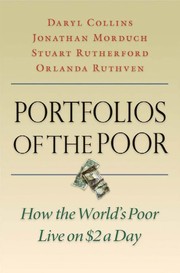
Portfolios of the Poor

Portfolios of the Poor

Daryl Collins, Jonathan Morduch, Stuart Rutherford, Orlanda Ruthven
2009
T2 283 pages · about 4h 43m to read Open Librarygoodreads

Financial diaries showing how poor Bangladeshi households actually manage money.

Summary

Collins, Morduch, Rutherford and Ruthven ran financial diaries with roughly 250 poor households in Bangladesh, India and South Africa, visiting each household every two weeks for a year and recording every financial transaction. The book reports what the diaries showed.

The central finding overturns the assumption that poor households have simple financial lives. The households in the study used a wide range of instruments simultaneously: savings clubs, moneylenders, shopkeeper credit, loans to and from relatives and neighbours, savings held with a neighbour for safekeeping, microfinance loans, insurance-like burial societies, and money kept at home. The average household used around ten distinct instruments over the year and moved sums through them far larger than their annual income.

The explanation is that the defining feature of poverty is not the low level of income but its irregularity and unpredictability. A household with an uncertain daily income must manage cash flow constantly, and the instruments exist to convert irregular income into the lump sums that school fees, funerals, illness and business inputs require. The authors call this the triple whammy: low incomes, irregular incomes, and a lack of financial instruments suited to managing them.

The policy implication is that the poor need reliable savings and payment services at least as much as credit, which the microfinance movement had underweighted. The evidence is a small non-representative sample, which the authors acknowledge, and the diaries method captures behaviour in detail at the cost of generalisability. It reoriented the field.

Key takeaways 7

  1. The defining problem of poverty is the irregularity and unpredictability of income rather than its level alone.
  2. Poor households manage complex financial portfolios, using around ten distinct instruments over a year and moving sums far exceeding their annual income.
  3. The poor need reliable savings and payment services at least as much as credit, which the microfinance movement systematically underweighted.
  4. Informal instruments including savings clubs, shopkeeper credit and reciprocal lending exist because they solve problems that formal products do not address.
  5. Interest rates on small short-duration informal loans appear extortionate when annualised and are frequently reasonable in the terms the borrower uses.
  6. Converting irregular small income flows into usable lump sums is the central financial task poor households face.
  7. Reliability and convenience matter more than price to poor households choosing a financial instrument, because the cost of a service failing is severe.

Who should read it

Founders and investors in financial inclusion who need to understand what poor households actually do with money before designing a product for them.

Who recommended it 1

Similar books 6

Chosen by shared topics, the entries that hold them, and the people who recommended both.

Beatriz Armendáriz, Jonathan Morduch · 2005

The theory behind microfinance methods such as group lending, and their effects.

Recommended by: Brian Armstrong
Muhammad Yunus · 1998

How $27 lent to 42 villagers grew into Grameen Bank and microcredit.

David Roodman · 2011

Sceptical audit of what microfinance evidence actually supports.

Michael Pettis · 2001

Emerging-market crises come from the structure of national balance sheets.

Daron Acemoglu, James A. Robinson · 2012

Nations prosper under inclusive institutions and stagnate under extractive ones.

Where it sits in the reference 2

Geographies
Economics

Topics

EconomicsFinance and MarketsPersonal finance and money habitsProductivity and Habits