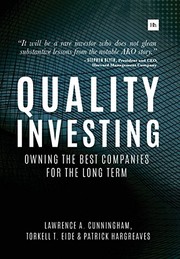
Quality Investing
The business attributes that let a firm take a toll year after year.
Summary
Cunningham, Eide and Hargreaves, working from the investment approach of AKO Capital, set out what makes a business high quality and therefore worth owning for long periods at prices that do not look cheap on conventional value measures.
Their framework has three components. Strong predictable cash generation, meaning the business converts profits to cash reliably without heavy reinvestment requirements. Sustained high returns on capital, which indicates a competitive advantage that has survived competitive attack. And attractive growth opportunities, meaning the business can reinvest at those returns rather than being forced to distribute.
The substance of the book is the set of patterns they identify as producing these characteristics. They cover recurring revenue models, businesses selling small-ticket items whose cost is trivial relative to the customer's total spending and whose failure would be expensive, companies with pricing power derived from brand or from switching costs, businesses benefiting from friendly middlemen who prefer to sell their product, toll roads and regulated monopolies, businesses with low penetration in a growing category, and corporate cultures that produce consistent operational improvement.
They also cover what destroys quality, including acquisitions outside the core, changes in ownership or management, technological change, and regulatory action.
The book is written from a manager's approach and the evidence is illustrative rather than statistical. Quality as a factor has an empirical basis in the academic literature, which the authors reference lightly. The main risk the book underweights is that quality businesses can be identified correctly and still produce poor returns because the quality is already in the price.
Key takeaways 7
- A high quality business combines strong cash conversion, sustained high returns on capital, and the ability to reinvest at those returns.
- Sustained high returns on capital are evidence that a competitive advantage has already survived attack, which is more informative than any qualitative assessment.
- Businesses selling low-cost items whose failure would be expensive to the customer have pricing power disproportionate to their share of the customer's spending.
- Recurring revenue models produce predictability that raises the value of a given level of earnings.
- A distributor or intermediary who prefers to sell your product because it is easier or more profitable for them is a durable advantage that is hard to observe from outside.
- Quality is destroyed most often by acquisitions outside the core business and by changes in ownership or management, not by competitors.
- Paying a high multiple for a genuinely high quality business can produce good returns over long periods, provided the returns on capital persist.
Who should read it
Long-horizon equity investors who want a framework for identifying durable business quality and the patterns that produce it.
About Lawrence A. Cunningham
Corporate-governance scholar and longtime George Washington University law professor; edits The Essays of Warren Buffett and writes on Berkshire and quality investing.
The Essays of Warren Buffett reorganises decades of Berkshire shareholder letters by subject - governance, accounting, mergers, valuation - turning scattered annual commentary into a usable manual. The later books extend the analysis to Berkshire's decentralised structure and to the traits that make a business durable enough to hold for decades.
University of Delaware, Quality Shareholders Group, George Washington University
Who recommended it 1 · 1 direct
Similar books 6
Chosen by shared topics, the entries that hold them, and the people who recommended both.
Berkshire's shareholder letters arranged by topic: governance, valuation, mergers.
“The resource is as valuable as Larry Cunningham's The Essays of Warren Buffett, which similarly organizes by subject matter” — Christopher Bloomstran
Source: Semper Augustus 2024 Letter to Clients, 'Books and Tunes for Walking', p. 96
Recommended by: Christopher Bloomstran, Francois Rochon and 11 others
Subtitled Stocks That Return 100-to-1 and How to Find Them; expanded edition 2025.
Recommended by: Mohnish Pabrai
Buy a few outstanding growth companies, research them by scuttlebutt, and hold.
“The late Philip Fisher wrote several books that are very good [including] Common Stocks and Uncommon Profits.” — Arnold Van Den Berg
Source: Van Den Berg on Fisher's books
Recommended by: Arnold Van Den Berg, Bill Stewart and 10 others
How to spot a durable economic moat from public information, and what isn't one.
Recommended by: Mohnish Pabrai
Eight CEOs who beat the market by allocating capital, not by running operations.
“…books I've recommended, highlighted to death, or forced on friends.” — Andrew Wilkinson
Source: Andrew Wilkinson's Bookshelf, neverenough.com
Recommended by: Andrew Wilkinson, Dan Loeb, Francois Rochon and 12 others
A fund manager of sixty years on investing, business and a long life.
Recommended by: Mohnish Pabrai
Where it sits in the reference 4
Topics