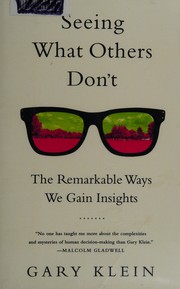
Seeing What Others Don't: The Remarkable Ways We Gain Insights
When, why and how insights form, and what blocks them.
Summary
Gary Klein, a cognitive psychologist who studies people in their natural settings, examines when, why and how insights form and what blocks them. Insights such as Darwin's grasp of evolution or Watson and Crick's discovery of the structure of DNA can change the world, and everyday insights help people solve problems, yet little is known about how they arise.
Klein draws on stories from scientists, businesspeople, firefighters, police officers, soldiers, family, friends and himself. He asks what let Harry Markopolos see through Bernie Madoff; how Dr Michael Gottlieb connected separate patients to publish the first announcement of the AIDS epidemic; what Admiral Yamamoto saw in a 1940 British attack on the Italian fleet that shaped his plan to attack Pearl Harbor; how a smokejumper saw that lighting another fire would save his life while those who ignored him died; and how Martin Chalfie came to the idea, which won a Nobel Prize, of a natural light that lets researchers watch processes inside living organisms. From such cases Klein builds an account of what insights are and how they happen.
Key takeaways 4
- Insights can be studied through real cases rather than only in laboratories.
- Seeing a contradiction or a connection often triggers an insight.
- Organisations can block insights as well as produce them.
- Markopolos, Yamamoto and Chalfie each saw what others missed in the same facts.
Who should read it
Managers, analysts and researchers who want to understand and encourage insight.
Who recommended it 2 · 2 direct
“I really wanted to like this book, but couldn't stomach the writing style. Instead of presenting his conclusions, you have to slog forever through his tales of how he went about his research, and how he felt about each step along the way to writing this book. I couldn't finish it.”
Similar books 6
Chosen by shared topics, the entries that hold them, and the people who recommended both.
Four traps that ruin decisions, such as narrow framing, and a process to beat each.
“Interesting and insightful dive into the subject of how to make big decisions. Specific useful advice.” — Derek Sivers
Source: Derek Sivers book notes (primary, rated list) · Rating: 8/10
Recommended by: Andrew Wilkinson, Derek Sivers and 6 others
Why people mistake luck for skill, above all in markets.
“Fooled By Randomness was unquestionably the best non-fiction book I read in 2005.” — Brad Feld
Source: Book Review: Fooled By Randomness — Feld Thoughts
Recommended by: Barton Biggs, Brad Feld, Derek Sivers and 15 others
A textbook of creative thinking.
“I haven't read it in decades, but Edward de Bono, Six Thinking Hats, he also had, I believe, a book called Lateral Thinking, which I found helpful.” — Tim Ferriss
Recommended by: Patrick O'Shaughnessy, Tim Ferriss
A method of parallel thinking that lets groups think together in coordinated steps.
Recommended by: Tim Ferriss

Principles of observation, inference and avoiding error, from the Holmes stories.
Recommended by: Mohnish Pabrai, Patrick O'Shaughnessy and 1 other
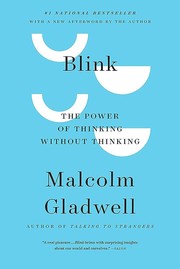
How snap judgments work, when to trust them and when they mislead.
“Malcolm Gladwell, Blink: The Power of Thinking Without Thinking (New York: Little, Brown and Company, 2005)” — Michael Mauboussin
Source: Are You an Expert? Experts and Markets, page 9
Recommended by: Michael Mauboussin, Mohnish Pabrai and 2 others