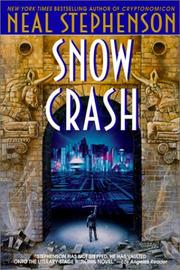
Snow Crash
A novel of a hacker in a corporate-run America and its virtual world, the Metaverse.
Summary
Stephenson's 1992 novel is set in a United States where the federal government has collapsed into a service provider among many, territory is divided among corporate franchise enclaves called burbclaves, and the Mafia runs pizza delivery under contractual time guarantees. The protagonist, Hiro Protagonist, delivers pizza and hacks, and moves between the physical world and the Metaverse, a shared virtual environment accessed through goggles where users appear as avatars whose quality reflects their money and skill.
The plot concerns a drug and computer virus called Snow Crash that operates on both software and human neurology, which Stephenson connects to Sumerian mythology and to a theory of language as a deep programming layer of the brain. Large sections consist of exposition delivered by a librarian program about Sumerian me, the Tower of Babel and the neurolinguistic hypothesis.
The book matters to technology readers because it named the Metaverse and the avatar in their modern senses, and because its picture of privatised governance, franchise sovereignty and virtual real estate has been used as a reference by many people building those things. Its influence on Second Life, on Google Earth, on cryptocurrency communities and on Facebook's 2021 renaming is direct and documented.
As a novel it is uneven. The Sumerian exposition is long and many readers find it unconvincing. The satire is broad and the characters are thin. Stephenson has said repeatedly that he wrote a satire and that people building products from it have missed the point. Read it for the vocabulary and the picture of privatised sovereignty, not as a prediction anyone should implement.
Key takeaways 7
- A persistent shared virtual environment with user-owned avatars and virtual real estate is described here in the form later technology companies attempted to build.
- Governments can fragment into competing franchise-based service providers, with sovereignty sold and enforced contractually rather than territorially.
- Language may function as a programming layer for the brain, which the novel uses to make an information virus operate on both machines and people.
- Status in a virtual environment tracks the money and technical skill invested in the avatar, reproducing physical-world hierarchy rather than removing it.
- Private security, private roads and private currency follow the withdrawal of the state, and the resulting society is more coercive rather than freer.
- Information itself can act as a weapon that disables people directly, without requiring any physical mechanism.
- The novel is written as satire, and Stephenson has objected to readers treating its arrangements as designs to be copied.
Who should read it
Technology founders and investors who want the source of the Metaverse vocabulary and a picture of privatised governance, read as satire rather than as a blueprint.
Who recommended it 15 · 2 direct
Similar books 6
Chosen by shared topics, the entries that hold them, and the people who recommended both.
A novel of wartime codebreakers and their descendants building a data haven.
“My favorite is probably Cryptonomicon, which I think is a rare choice as a favorite” — Tim Ferriss
Recommended by: Tim Ferriss, Ev Williams, Marc Andreessen and 1 other

A novel of the Singularity, when artificial intelligence surpasses the human mind.
Recommended by: Marc Andreessen, Nat Eliason and 1 other

A noir science fiction novel in which minds are stored and moved between bodies.
Recommended by: Marc Andreessen, Ryan Shea, Zooko Wilcox
The first novel of the Sprawl trilogy and the classic of cyberpunk.
“Neuromancer also, and I believe, and I'm not alone in this, that sci-fi is a great place to go looking for the future, right?” — Tim Ferriss
Recommended by: Tim Ferriss, Naval Ravikant

A physicist's stories, from fixing radios as a boy to Los Alamos and beyond.
“Autobiographical stories. Fun anecdotes. But they give a great glimpse into an approach to life: Doubt, challenge, and most importantly: test everything. Experiment. See what happens in the real-world, not in-theory. Applied not just to science, but how ants find food, talking to strangers in bars, sketching portraits, and playing a shaker in a Brazilian band.” — Derek Sivers
Source: Derek Sivers book notes (primary, rated list) · Rating: 6/10
Recommended by: Brian Armstrong, Derek Sivers, Jason Zweig and 20 others
A novel of a nanotech future and a stolen copy of an interactive teaching book.
Recommended by: Andrew Chen, Bill Gurley, Ev Williams and 2 others