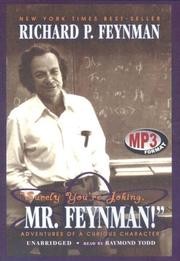
"Surely You're Joking, Mr. Feynman!"
A physicist's stories, from fixing radios as a boy to Los Alamos and beyond.
Summary
The book collects anecdotes Feynman told to Ralph Leighton over several years of drumming sessions, transcribed and edited into short chapters. It runs from his childhood repairing radios in Far Rockaway through Princeton, Los Alamos, Cornell, Caltech, the Brazilian physics teaching year, and the safe-cracking, painting and samba episodes that fill the later sections.
The recurring theme is a refusal to accept authority or convention as evidence. Feynman describes cracking safes at Los Alamos to demonstrate that the security procedures were theatre, testing whether ants navigate by trail by drawing paper bridges, and confronting Brazilian physics education where students could recite definitions but could not describe the phenomena the definitions named. His account of textbook selection for California schools describes committee members rating books nobody had read.
The most useful chapter for a working reader is Cargo Cult Science, the Caltech commencement address included at the end. Feynman argues that scientific integrity requires reporting everything that might make your result wrong, not just what supports it, and that a scientist must lean over backwards to show ways the conclusion could fail. He uses the Millikan oil drop history to show how successive researchers converged slowly on the right value because each was reluctant to depart far from the previous published number.
The book is entertaining rather than reliable. Feynman told these stories repeatedly and improved them, and several accounts have been disputed by other participants. His treatment of women in the bar-pickup chapter and elsewhere has drawn substantial criticism and reads badly now. There is almost no physics in it. Read it for an attitude toward problems, not for history or for science.
Key takeaways 8
- Understanding a thing means being able to describe what happens physically, not being able to state the definition.
- Scientific integrity requires actively reporting every piece of evidence that could show your conclusion is wrong.
- Researchers converge slowly on correct values because each is reluctant to publish a number far from the previous accepted one, which is a bias of the community rather than of the instrument.
- Authority and credentials provide no evidence, and Feynman tested claims himself rather than accepting them from senior people.
- Security systems, review committees and other institutional procedures frequently function as performance rather than as protection.
- Solving problems for pleasure rather than for career advancement produced Feynman's best work, including the plate-spinning observation that led to his Nobel-recognised results.
- Teaching that produces students who can pass examinations without being able to apply anything is a systematic failure, not a local one.
- A person should be willing to look foolish while learning something outside their field.
Who should read it
Readers who want a model of first-principles curiosity and the Cargo Cult Science essay on self-deception, with the anecdotes taken as entertainment.
Who recommended it 23 · 6 direct
“Autobiographical stories. Fun anecdotes. But they give a great glimpse into an approach to life: Doubt, challenge, and most importantly: test everything. Experiment. See what happens in the real-world, not in-theory. Applied not just to science, but how ants find food, talking to strangers in bars, sketching portraits, and playing a shaker in a Brazilian band.”
“Reading Feynman's recollections of his career of intellectual discovery, you'll see how hard he worked at honing his skepticism and learning to think for himself.”
Similar books 6
Chosen by shared topics, the entries that hold them, and the people who recommended both.
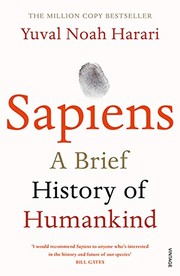
How shared fictions such as money, nations and gods let humans cooperate at scale.
“…books I've recommended, highlighted to death, or forced on friends.” — Andrew Wilkinson
Source: Andrew Wilkinson's Bookshelf, neverenough.com
Recommended by: Andrew Wilkinson, Bill Gates, David Perell and 40 others
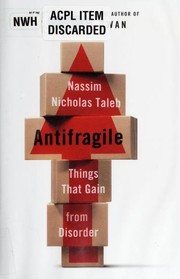
Why some things gain from volatility and disorder, and how to build them.
“Antifragile. Loved the first 1/3 and last 1/3 of this book.” — Andrew Chen
Source: Books I’m reading (2013)
Recommended by: Ana Fabrega, Andrew Chen, Derek Sivers and 24 others
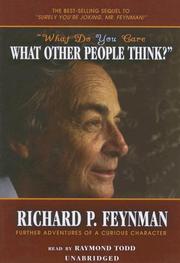
Stories of a physicist's first marriage and his inquiry into the Challenger disaster.
“Richard Feynman's books are awesome. Very bright physicist. Must-read!” — Mohnish Pabrai
Source: Mohnish's Bookshelf — Unorganized, yet Interesting, entry 169
Recommended by: Jason Zweig, Mohnish Pabrai, Naval Ravikant and 1 other
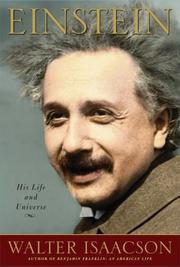
Einstein's life and science, from the Bern patent office to relativity.
Recommended by: Alfred Lin, Bill Gates, Charlie Munger and 7 others
Life in Nazi concentration camps, and logotherapy: finding meaning to survive.
“What's more certain to me is that we all need a why, as Viktor Frankl told us in Man's Search for Meaning.” — David Heinemeier Hansson
Source: Universal Basic Dead End
Recommended by: David Heinemeier Hansson, David Perell and 29 others
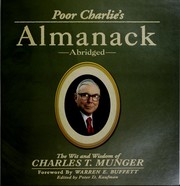
Speeches making the case for a latticework of mental models from many fields.
“…books I've recommended, highlighted to death, or forced on friends.” — Andrew Wilkinson
Source: Andrew Wilkinson's Bookshelf, neverenough.com
Recommended by: Andrew Wilkinson, Charlie Munger and 26 others
Where it sits in the reference 3
As an Amazon Associate I earn from qualifying purchases.