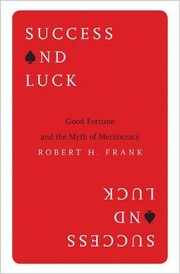
Success and Luck: Good Fortune and the Myth of Meritocracy
Chance shapes success more than people think; what that means for fairer economies.
Summary
Robert Frank, an economist and New York Times economics columnist, examines how much luck matters to economic success, a question that divides conservatives from liberals. Conservatives rightly note that people who build great fortunes are almost always talented and hard-working; liberals rightly note that many others with the same qualities never earn much.
Social scientists have found that chance plays a much larger part in important life outcomes than most people think. Frank explores what follows from those findings: why the rich underestimate luck in their success, and why that hurts everyone, the wealthy included. In a world of winner-take-all markets, he argues, chance opportunities and trivial early advantages grow into much larger ones and into huge differences in income over time. He explains how false beliefs about luck persist despite strong evidence, and argues that a more accurate understanding of luck could lead to richer and fairer economies and societies.
Key takeaways 4
- Chance shapes important life outcomes more than most people believe.
- Winner-take-all markets magnify small early advantages into large income gaps.
- The successful tend to underestimate the role of luck.
- Recognising luck could support better and fairer economic policy.
Who should read it
Readers interested in inequality, meritocracy and the economics of success.
Who recommended it 1 · 1 direct
Similar books 6
Chosen by shared topics, the entries that hold them, and the people who recommended both.
How positional spending on status goods drives American consumption.

How psychology, which Keynes called animal spirits, drives the economy.
Recommended by: Jim Collins, Mohnish Pabrai
Why people mistake luck for skill, above all in markets.
“Fooled By Randomness was unquestionably the best non-fiction book I read in 2005.” — Brad Feld
Source: Book Review: Fooled By Randomness — Feld Thoughts
Recommended by: Barton Biggs, Brad Feld, Derek Sivers and 15 others

Why evolved instincts push people toward bad choices on money, food and sex.
Recommended by: Mohnish Pabrai, Nassim Nicholas Taleb
People have no fixed sense of value, so context and anchors set the prices they pay.
“For a good popular treatment of this topic, see William Poundstone, Priceless: The Myth of Fair Value (and How to Take Advantage of It) (New York: Hill and Wang” — Michael Mauboussin
Source: Blaming the Rat: Incentives, Motivation, and How They Interact, page 14
Recommended by: Michael Mauboussin, Mohnish Pabrai and 1 other

Experiments showing most cheating is many people cheating a little.
Recommended by: Mohnish Pabrai