Updates

  1. Person pages list letters, writing, profiles and links as sortable tables with filters, and show each person's companies as links; Fund letters show each letter's description in its own column.
  2. Experts show a checked job title and a short description of each person; 30 more people have photographs.
  3. Every company, fund, university and publication the experts work for has a page listing the people there.
  4. Fund letters show each letter's thesis and filter by it; 225 person pages list the essays, columns and newsletter issues the person wrote.
  5. Person pages list every essay and newsletter issue a person wrote, and their own books as a table in List view.
  6. Recommends shows the five largest kinds of book and the rest under More; browse pictures load sooner.
  7. Podcasts and talks link the original episode, filter by Audio and video or Press, and list each publisher once.
  8. Pages are wider, Recommends has List and Grid, and a filter clicked again turns off.
  9. Book cards sit in a ruled grid with Open Library and Goodreads links and each book's one-line note.
  10. Funds is now Investors; each investor's styles are buttons that filter the table.
  11. Podcasts and talks on a person's page filter by year and publisher and show as a list or a grid of pictures.
  12. Quotes show only people's own words: 472 summaries written by list sites are gone.
  13. Country pages open from Browse again, and every link on the shelf lands on a page.
  14. Subject and person pages show their sections as tabs, and each book appears once on a person's page.
  15. Book cards show the quote, who said it and the source; grids show five cards to a row.
  16. On a phone, a menu holds the sections, search, Updates, Feedback and dark mode.
  17. Feedback takes a screenshot of the page with no browser prompt, opens a screenshot full size when you click it, and clears itself once sent.
  18. Book cards are centred, search names the topic each book sits in, and any text cut short shows whole on hover.
  19. Search groups its results by kind: people, companies, geographies, subjects, topics, books, funds, fund letters and papers.
  20. The Books table lists who recommended each book by name, and the browser tab names the section you are in.
  21. Feedback can take a screenshot of the page, or one you paste or choose, and opens in the corner beside Updates.
  22. Each rail button reopens its section where you left it, and Browse, Table and People show on every book and subject page.
  23. Filters grey out choices that hold nothing instead of hiding them, and Books › People filters by authors or recommenders.
  24. Feedback takes a subject line and up to three screenshots.
  25. Biographies are grouped by the person they are about: 41 new pages, from Abraham Lincoln to Lee Kuan Yew.
  26. Sport splits into 23 sports, and Religion into one topic per faith.
  27. Book lists show as cards: the cover, one recommendation quote and every recommender by name.
  28. Seventeen subjects that had two or three pages under different names now have one page each.
  29. Every page lists its Experts as authors and recommenders, with a link to them on the Experts tab.
  30. Economics, Financial history, Financial panics and Accounting are subjects of their own, with one page per financial crisis.
  31. Book, person and subject pages open inside the app, so the tabs stay in view.
  32. 996 more book covers, and photographs or logos for 227 more people and companies.
  33. Books › Browse shows every subject as cards, and the rail holds Fund letters, Papers, Experts, Books and Funds.
  34. Every topic over 150 books splits into narrower topics, each with a page of its own.

Send feedback

What is it?
Screenshots, up to 3 (optional)
or paste one with Ctrl+V

We use your email only to reply to you.

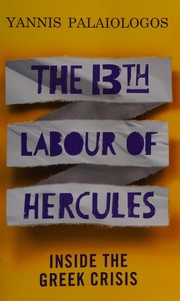
The 13th Labour of Hercules

The 13th Labour of Hercules

Yannis Palaiologos
2014
T3 270 pages · about 4h 30m to read Open Librarygoodreads

Reporting on how Greek institutions failed, sector by sector.

Summary

Yannis Palaiologos is a Greek journalist, and he wrote this account of his country's crisis from inside rather than from the perspective of European negotiations. His subject is the Greek state and economy as they actually function, and why the reforms demanded by creditors met the resistance they did.

The reporting proceeds through cases. He covers the closed professions, in which entry to occupations from pharmacy to trucking was restricted by licence, and the political constituencies that defended each. He covers the public administration, its hiring practices, and the clientelist relationship between parties and voters that made public employment a currency. He covers the health system, tax collection and evasion, the university system, and the shipping industry's special tax position. Each chapter follows individuals affected.

His argument is that Greece's crisis was a crisis of the state before it was a crisis of the euro or of sovereign debt, and that external pressure produced austerity without producing the institutional reforms that would have made recovery possible. He is critical of the creditors' programme design and equally critical of the Greek political class. The book was published in 2014, before the Syriza government, the 2015 referendum and the third bailout. It is journalism and offers no economic analysis of the debt sustainability question, which was the central technical dispute.

Key takeaways 7

  1. Greece's crisis originated in the failure of its state institutions rather than in the euro or in sovereign borrowing alone.
  2. Closed professions restricted entry to occupations across the economy and each restriction had a political constituency defending it.
  3. Public employment functioned as the currency of clientelist politics, which made administrative reform an attack on the party system.
  4. Austerity imposed by creditors reduced spending without reforming the institutions that made spending ineffective.
  5. Tax evasion in Greece was structural rather than marginal, and enforcement failed because the administration was itself politicised.
  6. Palaiologos argues that the Greek political class and the European creditors both preferred the fiction of a solvable liquidity problem.
  7. Reform failure produced the political conditions for the anti-establishment parties that followed.

Who should read it

Investors and analysts of the euro crisis who want the domestic institutional account of why Greek reform failed rather than the negotiation narrative.

Similar books 6

Chosen by shared topics, the entries that hold them, and the people who recommended both.
Yanis Varoufakis · 2016

The euro's design flaws traced back through the postwar monetary system.

Costas Meghir, Christopher A. Pissarides, Dimitri Vayanos, Nikolaos Vettas · 2017

How the Greek economy actually works: its product markets, courts and firms.

Jason Manolopoulos · 2011

Written by a hedge fund manager; strongest on the bond market's role in the build-up.

Michael Lewis · 2011

How Iceland, Greece, Ireland, Germany and California each spent cheap credit.

Peadar Kirby · 2010

Structural reading of why the growth model was fragile from the start.
Martin Sandbu · 2015

Argues the currency was not the problem, the crisis management was; the best contrarian case.

Where it sits in the reference 2

Geographies
Economics

Topics

Politics and GovernmentEconomicsEurope, Britain and Russia