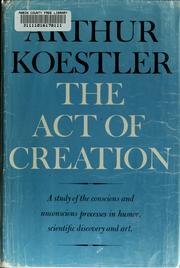
The Act of Creation
Creativity in humour, science and art as 'bisociation': joining two unrelated frames.
Summary
Arthur Koestler's 1964 book studies discovery, invention, imagination and creativity in humour, science and the arts, and attempts a general theory of human creativity. Comparing many examples of invention and discovery, he concludes that they share a pattern he calls "bisociation": the blending of elements from two previously unrelated frames of thought into a new frame of meaning, through comparison and abstraction.
Koestler holds that all creatures can be creative, but that the automatic routines of thought and behaviour that rule most lives often suppress the capacity. Psychology, he argues, had explained little about the creative process, and people are most creative when rational thought is suspended, as in dreams and trance-like states, when the mind is open to inspiration and insight. He takes humour as his starting point, examining the bisociative leap that produces a joke, and then applies the same analysis to the work of scientific and artistic genius.
Key takeaways 4
- Creativity joins two unrelated frames of thought into a new one.
- Koestler calls this mechanism bisociation.
- Humour, science and art share the same creative pattern.
- Habit and routine suppress creativity; suspending rational control can release it.
Who should read it
Readers interested in the psychology of creativity, discovery and humour.
Who recommended it 3 · 2 direct
Similar books 6
Chosen by shared topics, the entries that hold them, and the people who recommended both.
The theory that consciousness is learned, arising from a once two-chambered mind.
Recommended by: Patrick O'Shaughnessy, Adam Robinson and 3 others
How consciousness and the senses evolved, and the history of the mind.
Recommended by: Mohnish Pabrai, Nassim Nicholas Taleb
Metaphor as a basic mechanism of thought that shapes how people understand the world.
“Going to go a little esoteric for this next one and talk about a book, which is a little more academic, which is by an author named George Lakoff and it's called Metaphors We Live By. There's definitely a writing theme here.” — Matt Mullenweg
Recommended by: David Perell, Matt Mullenweg, Nat Eliason and 2 others
How thought and emotion are integrated as people develop through life.
Recommended by: Ray Dalio
Whether the universe embodies beautiful ideas, from a Nobel physicist.
Recommended by: Patrick Collison