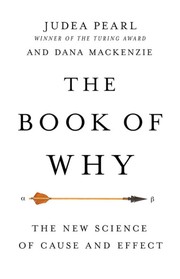
The Book of Why
How the science of cause and effect moved past 'correlation is not causation'.
Summary
Pearl, a Turing Award winner, and the writer Dana Mackenzie argue that statistics spent a century refusing to talk about cause and effect, and that a causal revolution since the mid-twentieth century has given it the tools to do so. The core device is the ladder of causation: association (is X related to Y), intervention (what happens to Y if I do X) and counterfactuals (what would have happened had X been different). Correlation and regression stay on the first rung.
The ten chapters run historically. They blame Karl Pearson for keeping statistics on the first rung, credit Sewall Wright's path diagrams, introduce Bayesian networks, and show how causal diagrams identify confounders so that, with a causal model, a randomised trial is not always needed. One chapter retells the smoking and lung cancer debate between Fisher, Cornfield and others; another resolves the Monty Hall problem and Simpson's paradox. Later chapters present the do-calculus, structural causal models, mediation and AI. Tim Maudlin argued that counterfactuals cannot be separated from causal claims as a distinct rung.
Key takeaways 5
- Data alone cannot answer causal questions; a model of how the variables cause one another is required.
- Causal questions come in three levels: association, intervention and counterfactual.
- A causal diagram shows which variables must be controlled for and which must not.
- With a valid causal model, some causal effects can be estimated from observational data without a randomised trial.
- Paradoxes such as Simpson's disappear once the causal structure behind the data is drawn.
Who should read it
Analysts, investors and researchers who draw conclusions from data and want to know when a correlation supports a causal claim.
Who recommended it 3
Similar books 6
Chosen by shared topics, the entries that hold them, and the people who recommended both.
A mathematical theory of causation for statistics, AI, economics and science.
How biased samples, chosen averages and cut-off chart axes make numbers mislead.
“This puckish riff on how math can be manipulated is only 142 pages; most people could read it on a train ride or two, or in an afternoon at the beach. As light as the book is, however, it is nevertheless profound. In one short take after another, Huff picks apart the ways in which marketers use statistics, charts, graphics and other ways of presenting numbers to baffle and trick the public.” — Jason Zweig
Source: Best Books for Investors: A Short Shelf — jasonzweig.com
Recommended by: Bill Gates, Jason Zweig, Mohnish Pabrai and 7 others
Statistics without the maths, for reading claims: averages, correlation, regression.
Recommended by: Keith Rabois
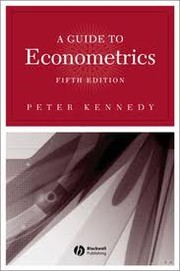
What each econometric technique is for, what it assumes and what goes wrong.
Recommended by: Nassim Nicholas Taleb
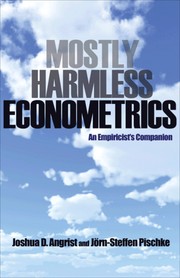
A practical guide to causal inference: regression, instruments, differences.
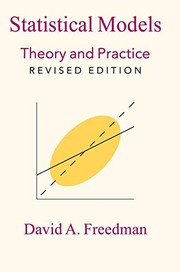
Regression's assumptions and the causal claims it cannot support.
Recommended by: Nassim Nicholas Taleb
Where it sits in the reference 1
Topics 4
As an Amazon Associate I earn from qualifying purchases.