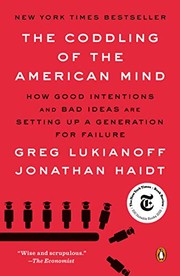
The Coddling of the American Mind
Three false beliefs taught to young Americans, and how they harm their minds.
Applies antifragility to universities; safety culture as manufactured fragility
Summary
Lukianoff, a free speech lawyer, and Haidt, a social psychologist, argue that three beliefs increasingly taught to young Americans are both false and psychologically harmful. The untruths are that what does not kill you makes you weaker, that you should always trust your feelings, and that life is a battle between good people and evil people.
Their argument is that these beliefs contradict established findings. Antifragility means that children require exposure to stressors to develop capability. Cognitive behavioural therapy works by identifying and correcting distorted thinking rather than trusting it, and the distortions it treats, including catastrophising, emotional reasoning and dichotomous thinking, are precisely what campus culture teaches. Us-versus-them thinking is a well-documented tribal default that institutions should suppress rather than encourage.
They identify six contributing causes: rising adolescent anxiety and depression from around 2012, paranoid parenting, the decline of unsupervised play, the growth of campus administrative bureaucracy, the intensification of political polarisation, and the rise of what they call justice thinking that focuses on equal outcomes.
The correlation between smartphone adoption and adolescent mental health is the empirical claim most disputed, and researchers including Amy Orben and Andrew Przybylski have argued that the effect sizes are very small. Critics also argue that the authors generalise from a small number of elite institutions and that they understate the substantive issues behind campus protests. The application of cognitive distortion categories to institutional culture is the most original element.
Key takeaways 8
- Children are antifragile and require exposure to stressors, difficulty and unsupervised conflict to develop capability.
- Protecting young people from discomfort produces the fragility that the protection was intended to prevent.
- Cognitive behavioural therapy works by identifying and correcting distorted thinking, which means teaching people to trust their feelings reverses the treatment.
- Campus culture teaches the specific cognitive distortions that therapy exists to correct, including catastrophising and emotional reasoning.
- Dividing people into good and evil groups is a tribal default that institutions should suppress rather than reinforce.
- Adolescent anxiety and depression rose sharply from around 2012, coinciding with smartphone and social media adoption.
- The decline of unsupervised play removed the setting in which children learned to resolve conflict without adult intervention.
- The correlation between smartphone use and adolescent mental health is disputed, with several researchers finding effect sizes too small to support the causal claim.
Who should read it
Readers thinking about how institutions handle disagreement and discomfort, with the empirical claims about smartphones treated as contested.
Who recommended it 4 · 1 direct
“A good companion read to "Winner Takes All".”
Similar books 6
Chosen by shared topics, the entries that hold them, and the people who recommended both.

Rare, unforeseen, high-impact events drive history, explained only after the fact.
“The Black Swan U The best-known bird around today is The Black Swan, the second book from Nassim Nicolas Taleb.” — Howard Marks
Source: The Complete Collection, page 530
Recommended by: David Perell, Howard Marks, Marc Andreessen and 20 others

Why some things gain from volatility and disorder, and how to build them.
“Antifragile. Loved the first 1/3 and last 1/3 of this book.” — Andrew Chen
Source: Books I’m reading (2013)
Recommended by: Ana Fabrega, Andrew Chen, Derek Sivers and 24 others
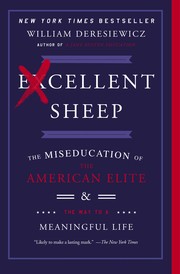
Why elite American colleges turn out bright conformists without direction.
Recommended by: Mohnish Pabrai, Nat Eliason
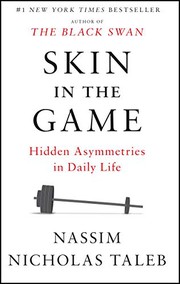
Why people who make decisions for others must share in the downside.
“Skin in the Game by @nntaleb is one of my all-time favorite books.” — Ana Fabrega
Source: Fab Fridays 88: How to Pick a Good Book - by Ana Lorena
Recommended by: Ana Fabrega, David Perell, Derek Sivers and 14 others

Multiculturalism and political intolerance on campus.
Collected journalism of a satirist who went from student radical to conservative.
Recommended by: Eric Weinstein