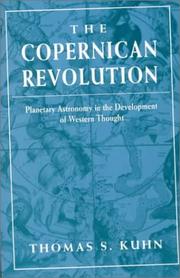
The Copernican Revolution
How the Copernican revolution unfolded, as a turning point in scientific thought.
Kuhn on how one model replaced another and why it took so long
Summary
Kuhn treats the Copernican Revolution as three things at once: an episode inside astronomy, a turning point in scientific thought, and a crisis in how Western people saw their relation to the universe and to God. He argues that few episodes show so clearly how solving a highly technical problem can change basic habits of thought.
The book opens with the first scientific cosmology, that of the Greeks, and the many functions, astronomical and religious, that their picture of the universe served. Kuhn then covers the intellectual, social and economic changes that prepared Copernicus's break with traditional astronomy, among them scholastic criticism of Aristotle's theory of motion and the Renaissance revival of Neoplatonism, which lay outside astronomy but loosened astronomers' imaginations. He discusses De revolutionibus orbium coelestium in detail, then its reception, the research that finally made the sun-centred system work, and the physics and metaphysics that made a moving Earth part of Newtonian science. Throughout he examines how theory, observation and belief relate. The journal Isis called it a superb analysis of the anatomy of revolution.
Key takeaways 4
- A technical problem in astronomy changed how Western people understood their place in the universe.
- Ideas from outside astronomy, such as criticism of Aristotle's physics, prepared the ground for Copernicus.
- The sun-centred system took further research before it worked better than the old one.
- Kuhn uses the episode to study how theory, observation and belief interact.
Who should read it
Readers interested in how one model of the world replaces another and why the change takes so long.
Who recommended it 2 · 2 direct
“Kuhn, The Copernican Revolution”
Similar books 6
Chosen by shared topics, the entries that hold them, and the people who recommended both.
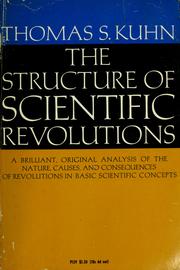
Science moves through long stretches of normal work broken by paradigm shifts.
“Thomas Kuhn laid out the best-known framework for this analysis in his seminal book,The Structure of Scientific Revolutions (1962).” — Michael Mauboussin
Source: Shift Happens: On a New Paradigm of the Markets as a Complex Adaptive System, page 2
Recommended by: Jim Collins, Michael Mauboussin, Nat Eliason and 8 others

Knowledge grows by bold guesses that we then try to refute, not by proof.
Recommended by: Patrick Collison

How a clockmaker solved the longitude problem, the hardest science of his day.
Recommended by: Jim Collins, Patrick Collison and 1 other

A non-technical story of the people and companies who built the first atomic bomb.
Recommended by: Patrick Collison
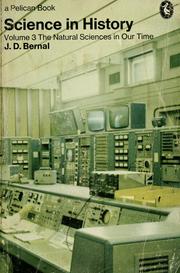
The relationship between science and society, from the flint axe to the H-bomb.
Recommended by: Patrick Collison
The late eighteenth-century discoveries that began the Romantic age of science.
Recommended by: Ed Cooke, Patrick Collison, Tyler Cowen
Where it sits in the reference 1
Topics 4
As an Amazon Associate I earn from qualifying purchases.