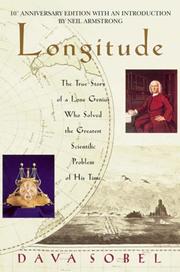
Longitude
How a clockmaker solved the longitude problem, the hardest science of his day.
Summary
Sobel tells how John Harrison, an eighteenth-century clockmaker, solved the longitude problem, the hardest scientific problem of his day. Without a way to measure longitude, sailors in the age of exploration were lost as soon as land was out of sight, and thousands of lives and the fortunes of nations depended on a solution. Against the scientific establishment, Harrison pursued a mechanical answer: a clock that would keep precise time at sea, which no clock had done even on land.
The book follows Harrison's forty-year obsession with building his timekeeper, now known as the chronometer, a story of heroism and chicanery, and gives a short history of astronomy, navigation and clockmaking along the way. Published in 1995, it was a bestseller and was made into a television series; The Illustrated Longitude (1998) added 180 images.
Key takeaways 4
- Harrison sought a mechanical answer to longitude, a clock that kept precise time at sea.
- Harrison worked in opposition to the scientific community of his day.
- Harrison spent forty years refining his chronometer against official resistance.
- Accurate navigation saved lives and decided national fortunes.
Who should read it
Readers who want a short, vivid history of a technological breakthrough and the outsider behind it.
Who recommended it 3 · 3 direct
Similar books 6
Chosen by shared topics, the entries that hold them, and the people who recommended both.

How the bomb was built, from the discovery of atomic energy to Hiroshima.
Recommended by: Jim Collins, Chris Dixon, Elon Musk and 2 others

A non-technical story of the people and companies who built the first atomic bomb.
Recommended by: Patrick Collison
The relationship between science and society, from the flint axe to the H-bomb.
Recommended by: Patrick Collison
The late eighteenth-century discoveries that began the Romantic age of science.
Recommended by: Ed Cooke, Patrick Collison, Tyler Cowen
How the Copernican revolution unfolded, as a turning point in scientific thought.
“Kuhn, The Copernican Revolution” — Paul Graham
Source: Rarely-Asked Questions — paulgraham.com
Recommended by: Patrick Collison, Paul Graham
Boulton, Watt, Wedgwood, Erasmus Darwin and the Midlands friends who experimented.
Recommended by: Mohnish Pabrai, Patrick Collison