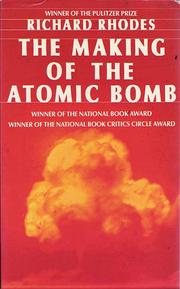
The Making of the Atomic Bomb
How the bomb was built, from the discovery of atomic energy to Hiroshima.
The origin of the industry and its physics, told definitively.
Summary
Rhodes tells how the atomic bomb was built, from the early twentieth-century discovery of the energy inside the atom, through the science of nuclear fission and the Manhattan Project, to the bombings of Hiroshima and Nagasaki. The span from theoretical discussion to the Trinity test was little more than twenty-five years. Scientists known only to their peers, among them Szilard, Teller, Oppenheimer, Bohr, Meitner, Fermi, Lawrence and von Neumann, moved into public life as a speculative problem in physics became a weapon.
The narrative lets participants speak in long passages of direct quotation and draws on interviews and correspondence with 21 participants and on oral histories collected by the American Institute of Physics. Its accounts of the two bombings are dense with first-hand testimony. It won the Pulitzer Prize, the National Book Award and the National Book Critics Circle Award. Barton Hacker noted that it gives little attention to institutions, and that experiments fill more pages than the production plants of an enterprise as large as the prewar American car industry. Rhodes continued the story in three further volumes, starting with Dark Sun.
Key takeaways 4
- Fission went from a speculative physics problem to a working weapon in about twenty-five years.
- The bomb depended on a small number of physicists who moved from academic research into government service.
- The Manhattan Project was an industrial enterprise comparable in scale to the prewar American car industry.
- First-hand accounts of Hiroshima and Nagasaki show the human cost that the technical history leads to.
Who should read it
Readers who want the standard history of the bomb and of the physics behind it, and anyone studying how large technical projects get organised under pressure.
Who recommended it 5 · 1 direct
Similar books 6
Chosen by shared topics, the entries that hold them, and the people who recommended both.
The 1986 Chernobyl disaster, and the secrecy and myth that hid what happened.
Recommended by: Casey Neistat
Nuclear accidents, what went wrong in each, and what each taught about the atom.
A history of human invention, and a corrective to the hype around innovation.
Recommended by: Bill Gates
How a clockmaker solved the longitude problem, the hardest science of his day.
Recommended by: Jim Collins, Patrick Collison and 1 other
Nineteenth-century cases of technological change and how society reacted to it.
Recommended by: Patrick Collison, Marc Andreessen