
Updates

  1. Person pages list letters, writing, profiles and links as sortable tables with filters, and show each person's companies as links; Fund letters show each letter's description in its own column.
  2. Experts show a checked job title and a short description of each person; 30 more people have photographs.
  3. Every company, fund, university and publication the experts work for has a page listing the people there.
  4. Fund letters show each letter's thesis and filter by it; 225 person pages list the essays, columns and newsletter issues the person wrote.
  5. Person pages list every essay and newsletter issue a person wrote, and their own books as a table in List view.
  6. Recommends shows the five largest kinds of book and the rest under More; browse pictures load sooner.
  7. Podcasts and talks link the original episode, filter by Audio and video or Press, and list each publisher once.
  8. Pages are wider, Recommends has List and Grid, and a filter clicked again turns off.
  9. Book cards sit in a ruled grid with Open Library and Goodreads links and each book's one-line note.
  10. Funds is now Investors; each investor's styles are buttons that filter the table.
  11. Podcasts and talks on a person's page filter by year and publisher and show as a list or a grid of pictures.
  12. Quotes show only people's own words: 472 summaries written by list sites are gone.
  13. Country pages open from Browse again, and every link on the shelf lands on a page.
  14. Subject and person pages show their sections as tabs, and each book appears once on a person's page.
  15. Book cards show the quote, who said it and the source; grids show five cards to a row.
  16. On a phone, a menu holds the sections, search, Updates, Feedback and dark mode.
  17. Feedback takes a screenshot of the page with no browser prompt, opens a screenshot full size when you click it, and clears itself once sent.
  18. Book cards are centred, search names the topic each book sits in, and any text cut short shows whole on hover.
  19. Search groups its results by kind: people, companies, geographies, subjects, topics, books, funds, fund letters and papers.
  20. The Books table lists who recommended each book by name, and the browser tab names the section you are in.
  21. Feedback can take a screenshot of the page, or one you paste or choose, and opens in the corner beside Updates.
  22. Each rail button reopens its section where you left it, and Browse, Table and People show on every book and subject page.
  23. Filters grey out choices that hold nothing instead of hiding them, and Books › People filters by authors or recommenders.
  24. Feedback takes a subject line and up to three screenshots.
  25. Biographies are grouped by the person they are about: 41 new pages, from Abraham Lincoln to Lee Kuan Yew.
  26. Sport splits into 23 sports, and Religion into one topic per faith.
  27. Book lists show as cards: the cover, one recommendation quote and every recommender by name.
  28. Seventeen subjects that had two or three pages under different names now have one page each.
  29. Every page lists its Experts as authors and recommenders, with a link to them on the Experts tab.
  30. Economics, Financial history, Financial panics and Accounting are subjects of their own, with one page per financial crisis.
  31. Book, person and subject pages open inside the app, so the tabs stay in view.
  32. 996 more book covers, and photographs or logos for 227 more people and companies.
  33. Books › Browse shows every subject as cards, and the rail holds Fund letters, Papers, Experts, Books and Funds.
  34. Every topic over 150 books splits into narrower topics, each with a page of its own.

Send feedback

What is it?
Screenshots, up to 3 (optional)
or paste one with Ctrl+V

We use your email only to reply to you.

The Credit-Anstalt Crisis of 1931

The Credit-Anstalt Crisis of 1931

Aurel Schubert
1991
T3 205 pages · about 3h 25m to read Open Librarygoodreads

The definitive study of the bank failure that broke Central European finance.

Summary

Aurel Schubert examines the failure of Austria's largest bank in May 1931, which is conventionally described as the event that spread the Depression from the United States to Europe and triggered the collapse of the international financial system.

Schubert's research, using Austrian bank and central bank archives, complicates that account. He shows that Credit-Anstalt's problems were long-standing and domestic: the bank had been weakened by the collapse of the Habsburg empire, which left it with claims across successor states and with industrial holdings whose markets had been fragmented by new borders; it had been forced by the government to absorb other failing banks, including Bodencreditanstalt in 1929, which transferred their losses onto its own balance sheet; and its industrial participations had been unprofitable for years. The 1931 announcement of a loss was the disclosure of a condition that had existed for a decade.

He also examines the international transmission and argues that the causal chain from Vienna to the German banking crisis and then to sterling's departure from gold is weaker than the standard account holds. Austria was small and its banking system was not deeply connected to Germany's, and the German crisis had its own domestic causes. Schubert's account is quantitative and archival and is the standard reference on the episode. It is a specialist work and assumes familiarity with interwar financial history.

Key takeaways 7

  1. Credit-Anstalt's problems were long-standing and domestic rather than the result of contagion from the American crisis.
  2. The collapse of the Habsburg empire left the bank with industrial holdings whose markets had been divided by new national borders.
  3. The Austrian government forced Credit-Anstalt to absorb other failing banks, which transferred their losses onto its balance sheet.
  4. The 1931 loss announcement disclosed a condition that had existed for years rather than reporting a new deterioration.
  5. Schubert argues that the causal link from Vienna to the German banking crisis is weaker than the standard account holds.
  6. Rescuing a failing bank by merging it into a stronger one converts one insolvency into two.
  7. Austria's banking crisis was resolved by state absorption of losses, which transferred the problem to the sovereign.

Who should read it

Financial historians and investors interested in banking contagion who want the archival case against a widely repeated causal story.

Similar books 6

Chosen by shared topics, the entries that hold them, and the people who recommended both.

Barry Eichengreen · 1992

How the gold standard spread the Depression, and why leaving it early meant recovery.
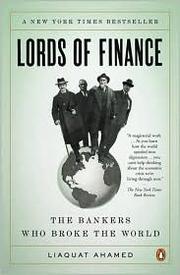
Liaquat Ahamed · 2009

How four central bankers and the gold standard turned a slump into the Depression.

“I'm going to use "classic" again but rightfully so.” — Christopher Bloomstran

Source: Semper Augustus 2020 Letter to Clients, 'To Read or Not to Read', p. 57

Recommended by: Christopher Bloomstran, Mohnish Pabrai

Charles P. Kindleberger · 1973

The Depression ran deep because no country would act as the world's stabiliser.

T4 1929
Andrew Ross Sorkin · 2025

The 1929 Wall Street crash: the greed and folly behind America's greatest collapse.

Recommended by: Bill Gates, Howard Marks

Murray N. Rothbard · 1963

The Austrian account of 1929 and the policy response that followed

Barry Eichengreen · 2015

How 1930s lessons guided policy in 2008, averting a depression but adding errors.

Where it sits in the reference 2

Geographies
Financial panics

Topics

Financial HistoryGeneral HistoryFinancial History