Updates

  1. Person pages list letters, writing, profiles and links as sortable tables with filters, and show each person's companies as links; Fund letters show each letter's description in its own column.
  2. Experts show a checked job title and a short description of each person; 30 more people have photographs.
  3. Every company, fund, university and publication the experts work for has a page listing the people there.
  4. Fund letters show each letter's thesis and filter by it; 225 person pages list the essays, columns and newsletter issues the person wrote.
  5. Person pages list every essay and newsletter issue a person wrote, and their own books as a table in List view.
  6. Recommends shows the five largest kinds of book and the rest under More; browse pictures load sooner.
  7. Podcasts and talks link the original episode, filter by Audio and video or Press, and list each publisher once.
  8. Pages are wider, Recommends has List and Grid, and a filter clicked again turns off.
  9. Book cards sit in a ruled grid with Open Library and Goodreads links and each book's one-line note.
  10. Funds is now Investors; each investor's styles are buttons that filter the table.
  11. Podcasts and talks on a person's page filter by year and publisher and show as a list or a grid of pictures.
  12. Quotes show only people's own words: 472 summaries written by list sites are gone.
  13. Country pages open from Browse again, and every link on the shelf lands on a page.
  14. Subject and person pages show their sections as tabs, and each book appears once on a person's page.
  15. Book cards show the quote, who said it and the source; grids show five cards to a row.
  16. On a phone, a menu holds the sections, search, Updates, Feedback and dark mode.
  17. Feedback takes a screenshot of the page with no browser prompt, opens a screenshot full size when you click it, and clears itself once sent.
  18. Book cards are centred, search names the topic each book sits in, and any text cut short shows whole on hover.
  19. Search groups its results by kind: people, companies, geographies, subjects, topics, books, funds, fund letters and papers.
  20. The Books table lists who recommended each book by name, and the browser tab names the section you are in.
  21. Feedback can take a screenshot of the page, or one you paste or choose, and opens in the corner beside Updates.
  22. Each rail button reopens its section where you left it, and Browse, Table and People show on every book and subject page.
  23. Filters grey out choices that hold nothing instead of hiding them, and Books › People filters by authors or recommenders.
  24. Feedback takes a subject line and up to three screenshots.
  25. Biographies are grouped by the person they are about: 41 new pages, from Abraham Lincoln to Lee Kuan Yew.
  26. Sport splits into 23 sports, and Religion into one topic per faith.
  27. Book lists show as cards: the cover, one recommendation quote and every recommender by name.
  28. Seventeen subjects that had two or three pages under different names now have one page each.
  29. Every page lists its Experts as authors and recommenders, with a link to them on the Experts tab.
  30. Economics, Financial history, Financial panics and Accounting are subjects of their own, with one page per financial crisis.
  31. Book, person and subject pages open inside the app, so the tabs stay in view.
  32. 996 more book covers, and photographs or logos for 227 more people and companies.
  33. Books › Browse shows every subject as cards, and the rail holds Fund letters, Papers, Experts, Books and Funds.
  34. Every topic over 150 books splits into narrower topics, each with a page of its own.

Send feedback

What is it?
Screenshots, up to 3 (optional)
or paste one with Ctrl+V

We use your email only to reply to you.

The East Asian Miracle

The East Asian Miracle

World Bank
1993
T2 389 pages · about 6h 29m to read Open Librarygoodreads

The official pre-crisis interpretation; read alongside Studwell to see what it missed.

Summary

The World Bank published this study in 1993 under pressure from the Japanese government, which had funded it and which wanted the Bank to acknowledge that East Asian governments had intervened successfully in their economies. The result is a negotiated document that reflects the internal conflict.

The study examines eight high-performing Asian economies and asks what produced their growth. Its conclusions attribute most of the outcome to what it calls the fundamentals: macroeconomic stability, high savings and investment, investment in primary education, agricultural policies that did not tax farmers heavily, and openness to foreign technology. It then examines selective interventions, including directed credit, export promotion, and industrial targeting, and reaches a mixed verdict: export promotion is judged successful, directed credit judged possibly beneficial in some cases, and industrial targeting judged unsuccessful.

The document's central concept is the market-friendly approach, in which government intervention is acceptable where it addresses a market failure and where results are monitored against export performance. Critics from the developmental state tradition, including Robert Wade and Alice Amsden, argued that the study systematically understated the interventions and that its methodology was designed to reach a predetermined conclusion. Critics from the other direction argued that it conceded too much. Paul Krugman's contemporaneous argument that East Asian growth reflected factor accumulation rather than productivity is a separate challenge. The report matters as an institutional document as much as an analysis.

Key takeaways 7

  1. The report attributes most East Asian growth to macroeconomic stability, high savings, primary education and agricultural policy rather than to industrial policy.
  2. Export promotion is judged successful because export performance supplied an objective test that governments could apply to firms.
  3. Industrial targeting is judged unsuccessful, and the report finds little evidence that targeted sectors outperformed.
  4. The market-friendly framework permits intervention where a market failure exists and where results can be monitored.
  5. Directed credit produced mixed results and worked only where allocation was tied to measurable performance.
  6. The report is a negotiated institutional document produced under pressure from its Japanese funder, which shaped its conclusions.
  7. Critics from the developmental state tradition argue the methodology understated the interventions it examined.

Who should read it

Analysts of industrial policy who need the institutional statement that framed the debate, read with awareness of how it was produced.

Similar books 6

Chosen by shared topics, the entries that hold them, and the people who recommended both.
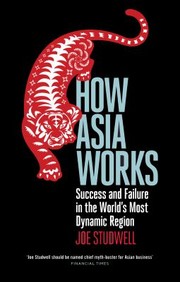
Joe Studwell · 2013

Why some Asian nations grew rich: land reform, export-led industry, directed credit.

“it's a good read for anyone who wants to understand what actually determines whether a developing economy will succeed.” — Bill Gates

Source: Gates Notes review of How Asia Works

Recommended by: Bill Gates, Mohnish Pabrai, Patrick Collison

Neil Monnery · 2017

John Cowperthwaite, Hong Kong's Financial Secretary in the 1960s, and his policies.

Montek Singh Ahluwalia · 2019

Insider memoir by the architect of much of the reform programme.

David Lewis · 2011

The one readable overview of how the state, NGOs and business interlock.

Just Faaland, J. R. Parkinson · 1976

The founding pessimist study; useful baseline for what was later beaten.

Alice H. Amsden, Wan-wen Chu · 2003

How Taiwan moved into higher-value industries after its first industrialisation.

Where it sits in the reference 2

Geographies
Economics

Topics

EconomicsPolitics and GovernmentAsia and the Pacific