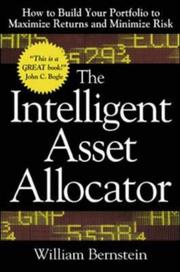
The Intelligent Asset Allocator
The other side: diversification as the only free lunch.
Summary
Bernstein, a neurologist who became a writer on investing, presents modern portfolio theory for individual investors, with the mathematics explained at a level requiring no prior background but not avoided. His central argument is that the allocation between asset classes determines the large majority of portfolio outcomes, that combining assets with low correlations reduces portfolio variance without a proportional reduction in return, and that rebalancing between them captures a return that neither asset produces alone.
The analytical material covers the calculation of returns and standard deviations, the effect of correlation on portfolio variance, the efficient frontier and its instability across periods, and the practical point that matters most that the optimal historical allocation is not knowable in advance and that portfolio optimisation techniques overfit past data.
His practical recommendations include holding several uncorrelated asset classes including domestic and international equities, small and large capitalisations, value and growth, and bonds; rebalancing on a schedule rather than on judgment; using index funds for implementation; and setting the equity proportion by capacity to tolerate loss rather than by expected return.
He also covers the history of returns across asset classes and periods, the effect of costs and taxes, and the behavioural failures that cause investors to abandon an allocation at the point where holding it matters. The book is short and mathematically honest, which distinguishes it from most retail investment writing. The specific asset class return data dates. His warning that optimisation overfits historical data applies directly to the tools that have since become widely available to individual investors.
Key takeaways 8
- Allocation between asset classes determines the large majority of portfolio outcomes rather than security selection or timing.
- Combining assets with low correlations reduces portfolio variance without a proportional reduction in expected return.
- Rebalancing between uncorrelated assets on a schedule captures a return that neither asset produces on its own.
- The historically optimal allocation is not knowable in advance, and optimisation techniques applied to past data systematically overfit it.
- The efficient frontier calculated from one period differs substantially from the next, which limits what optimisation can deliver.
- The equity proportion should be set by capacity to tolerate loss rather than by expected return, since an abandoned allocation returns nothing.
- Costs and taxes compound against the investor and should be treated as the one variable entirely within their control.
- Investors abandon allocations at precisely the point where holding them matters, which is the behavioural failure the whole method exists to prevent.
Who should read it
Individual investors who want portfolio theory explained with the mathematics intact rather than avoided.
About William J. Bernstein
Neurologist turned investment theorist; principal, Efficient Frontier Advisors; author and financial historian
Serious, widely cited writing on asset allocation plus economic histories that outlived their news cycle, though he has no public money-management record.
Who recommended it 1
Similar books 6
Chosen by shared topics, the entries that hold them, and the people who recommended both.

Interviews with 50 investors, from Dalio to Bogle, turned into money advice.
“…books I've recommended, highlighted to death, or forced on friends.” — Andrew Wilkinson
Source: Andrew Wilkinson's Bookshelf, neverenough.com
Recommended by: Andrew Wilkinson, Nat Eliason, Ray Dalio and 1 other
How Markowitz, Sharpe, Fama, Black and Scholes built the theory of modern finance.

Research Foundation of the CFA Institute monograph.
Markets pay skilled active managers; a survey of the strategies they run.


How the Yale endowment invests, and how institutions can build portfolios like it.
“As David Swensen wrote in his excellent book, "Pioneering Portfolio Management” — Howard Marks
Source: Oaktree memo 'Risk'
Recommended by: Howard Marks, Marc Andreessen and 2 others
Where it sits in the reference 4
Topics