Updates

  1. Person pages list letters, writing, profiles and links as sortable tables with filters, and show each person's companies as links; Fund letters show each letter's description in its own column.
  2. Experts show a checked job title and a short description of each person; 30 more people have photographs.
  3. Every company, fund, university and publication the experts work for has a page listing the people there.
  4. Fund letters show each letter's thesis and filter by it; 225 person pages list the essays, columns and newsletter issues the person wrote.
  5. Person pages list every essay and newsletter issue a person wrote, and their own books as a table in List view.
  6. Recommends shows the five largest kinds of book and the rest under More; browse pictures load sooner.
  7. Podcasts and talks link the original episode, filter by Audio and video or Press, and list each publisher once.
  8. Pages are wider, Recommends has List and Grid, and a filter clicked again turns off.
  9. Book cards sit in a ruled grid with Open Library and Goodreads links and each book's one-line note.
  10. Funds is now Investors; each investor's styles are buttons that filter the table.
  11. Podcasts and talks on a person's page filter by year and publisher and show as a list or a grid of pictures.
  12. Quotes show only people's own words: 472 summaries written by list sites are gone.
  13. Country pages open from Browse again, and every link on the shelf lands on a page.
  14. Subject and person pages show their sections as tabs, and each book appears once on a person's page.
  15. Book cards show the quote, who said it and the source; grids show five cards to a row.
  16. On a phone, a menu holds the sections, search, Updates, Feedback and dark mode.
  17. Feedback takes a screenshot of the page with no browser prompt, opens a screenshot full size when you click it, and clears itself once sent.
  18. Book cards are centred, search names the topic each book sits in, and any text cut short shows whole on hover.
  19. Search groups its results by kind: people, companies, geographies, subjects, topics, books, funds, fund letters and papers.
  20. The Books table lists who recommended each book by name, and the browser tab names the section you are in.
  21. Feedback can take a screenshot of the page, or one you paste or choose, and opens in the corner beside Updates.
  22. Each rail button reopens its section where you left it, and Browse, Table and People show on every book and subject page.
  23. Filters grey out choices that hold nothing instead of hiding them, and Books › People filters by authors or recommenders.
  24. Feedback takes a subject line and up to three screenshots.
  25. Biographies are grouped by the person they are about: 41 new pages, from Abraham Lincoln to Lee Kuan Yew.
  26. Sport splits into 23 sports, and Religion into one topic per faith.
  27. Book lists show as cards: the cover, one recommendation quote and every recommender by name.
  28. Seventeen subjects that had two or three pages under different names now have one page each.
  29. Every page lists its Experts as authors and recommenders, with a link to them on the Experts tab.
  30. Economics, Financial history, Financial panics and Accounting are subjects of their own, with one page per financial crisis.
  31. Book, person and subject pages open inside the app, so the tabs stay in view.
  32. 996 more book covers, and photographs or logos for 227 more people and companies.
  33. Books › Browse shows every subject as cards, and the rail holds Fund letters, Papers, Experts, Books and Funds.
  34. Every topic over 150 books splits into narrower topics, each with a page of its own.

Send feedback

What is it?
Screenshots, up to 3 (optional)
or paste one with Ctrl+V

We use your email only to reply to you.

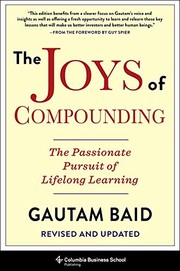
The Joys of Compounding

The Joys of Compounding

Gautam Baid
2019
T4 456 pages · about 7h 36m to read Open Librarygoodreads

Summary

Gautam Baid works as a portfolio manager and wrote this as a personal synthesis of value investing and of the multidisciplinary learning approach associated with Charlie Munger. It is explicitly derivative and does not claim originality.

The first part concerns learning: Baid argues for reading widely across disciplines, building what Munger calls a latticework of mental models, and treating compounding of knowledge as analogous to compounding of capital. He covers the specific cognitive biases from Munger's psychology of human misjudgement and from the behavioural finance literature, and the habits he considers necessary, including keeping a decision journal and reviewing errors.

The second part covers investing practice: the margin of safety, quality businesses and what makes returns on capital durable, position sizing and concentration, the importance of holding through volatility, the treatment of cash, and the specific characteristics Baid looks for in Indian companies, which is where he has worked. He quotes extensively from Buffett, Munger, Graham, Marks and others, and the book functions partly as an anthology of investment writing with connecting commentary. Its weakness is that it restates well-established positions without adding evidence or challenging them, and readers familiar with the sources will find little new. As a single volume for someone encountering this tradition for the first time, it is thorough and honest about its debts.

Key takeaways 7

  1. Baid argues that knowledge compounds like capital, which makes continuous reading across disciplines the investor's principal long-term investment.
  2. A latticework of models from multiple disciplines produces better judgement than depth in finance alone.
  3. Position sizing and the willingness to hold through volatility determine returns more than security selection does.
  4. Durable returns on capital require a specific mechanism preventing competitors from entering, and identifying it is the analytical task.
  5. Keeping a written record of the reasoning behind each decision is the only defence against hindsight bias.
  6. Temperament rather than intelligence determines investment outcomes, which is the tradition's central claim and Baid restates it.
  7. The book is explicitly derivative and functions partly as an anthology of the value investing literature with commentary.

Who should read it

Investors new to the value investing and mental models tradition who want a single thorough synthesis before going to the primary sources.

Similar books 6

Chosen by shared topics, the entries that hold them, and the people who recommended both.
Christopher Mayer · 2015

Subtitled Stocks That Return 100-to-1 and How to Find Them; expanded edition 2025.

Recommended by: Mohnish Pabrai
Philip L. Carret, Philip Carret · 1995

A fund manager of sixty years on investing, business and a long life.

Recommended by: Mohnish Pabrai
Philip Fisher · 1958

Buy a few outstanding growth companies, research them by scuttlebutt, and hold.

“The late Philip Fisher wrote several books that are very good [including] Common Stocks and Uncommon Profits.” — Arnold Van Den Berg

Source: Van Den Berg on Fisher's books

Recommended by: Arnold Van Den Berg, Bill Stewart and 10 others
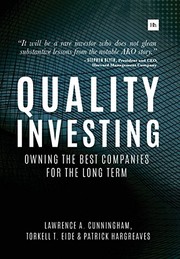
Lawrence A. Cunningham, Torkell T. Eide, Patrick Hargreaves · 2016

What makes a business high quality and worth owning for years at a fair price.

Recommended by: Patrick O'Shaughnessy
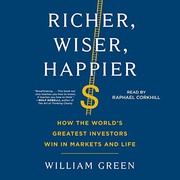
William Green · 2021

Lessons from 25 years of interviews with investors from Templeton to Munger.

“William has written the kind of book that we would love to have written but know that we lack the requisite skills.” — Nick Sleep

Source: Nick Sleep and Qais Zakaria, Postamble to the full collection of the Nomad Letters to Partners, p. 219

Recommended by: Nick Sleep

Where it sits in the reference 1

Investment philosophy

Topics

Investing