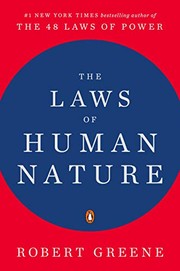
The Laws of Human Nature
Summary
Greene organises the book as eighteen laws, each naming a pattern of human behaviour and prescribing a response: irrationality, narcissism, role-playing and the masks people wear, compulsive behaviour and character, covetousness, short-sightedness, defensiveness, self-sabotage, repression, envy, grandiosity, gender rigidity, aimlessness, conformity, fickleness, aggression, generational attitudes, and death denial.
The method is consistent across Greene's work: each law opens with an extended historical or biographical case, extracts a pattern, and then gives advice on recognising it in others and in oneself. The sources here are more psychological than in his earlier books, drawing on Jung, Melanie Klein, Bowlby's attachment work, Milgram, Zimbardo and Goffman on self-presentation, alongside the biographical material. His recurring practical instruction is to read people from behaviour over time rather than from statements, to attend to what people do under pressure, and to assume that stated motives conceal rather than reveal.
The book is long and each chapter can be read alone. It is useful for anyone whose work depends on assessing people, and the material on narcissism, on envy as a concealed motive, and on how people behave in groups is the most applicable. The problems are methodological. Greene selects historical episodes to illustrate conclusions he has already reached, the psychological research he cites includes findings that have not replicated, particularly the Zimbardo and Milgram material, and the framework is unfalsifiable in the way that most character typologies are. Read it as organised observation rather than as science.
Key takeaways 7
- People act from motives they do not acknowledge and frequently do not perceive, so stated reasons should be treated as evidence about self-image rather than about cause.
- Character is revealed by patterns of behaviour under pressure over time, and a single impressive interaction carries almost no information.
- Envy is the most concealed of common motives and usually presents as criticism, condescension or unsolicited advice rather than as open resentment.
- Everyone performs a role in social settings, and reading the gap between the performance and the involuntary signals is the practical skill.
- People repeat compulsive patterns from early relationships in their professional lives, so a person's history of relationships predicts their future ones.
- Groups reduce individual judgement and raise conformity, and a person's behaviour inside a group is a poor guide to their behaviour outside it.
- Attention to one's own shadow, meaning the traits one denies, is what prevents those traits from directing behaviour without one noticing.
Who should read it
Founders and investors whose work depends on judging people, read as organised observation with awareness that its psychological citations are uneven.
About Robert Greene
American author of books on power, strategy, mastery and human behaviour, built from historical case studies.
The 48 Laws of Power catalogues the tactics used in courts, armies and businesses, stated as rules with historical cases on both the observance and the violation of each. Mastery examines how practitioners across fields moved from apprenticeship to independent judgement over decades of deliberate work.
Who recommended it 2 · 1 direct
“If you've ever been curious about psychology or human behavior, it is by far the most comprehensive and memorable book I've found.”
Similar books 6
Chosen by shared topics, the entries that hold them, and the people who recommended both.
Forty-eight rules for gaining and keeping power, each shown by historical episodes.
Recommended by: Nat Eliason, Ryan Holiday, Iman Gadzhi and 3 others

Seducer types, victim types and a step-by-step process of attraction from history.
Recommended by: Nat Eliason

Four steps to speak without blame: observations, feelings, needs and requests.
Recommended by: Andrew Wilkinson, Dustin Moskovitz and 3 others

Recommended by: Ramit Sethi, Tim Ferriss
A step-by-step approach to business negotiation from Wharton's negotiation workshop.

Where it sits in the reference 2
Topics