Updates

  1. Person pages list letters, writing, profiles and links as sortable tables with filters, and show each person's companies as links; Fund letters show each letter's description in its own column.
  2. Experts show a checked job title and a short description of each person; 30 more people have photographs.
  3. Every company, fund, university and publication the experts work for has a page listing the people there.
  4. Fund letters show each letter's thesis and filter by it; 225 person pages list the essays, columns and newsletter issues the person wrote.
  5. Person pages list every essay and newsletter issue a person wrote, and their own books as a table in List view.
  6. Recommends shows the five largest kinds of book and the rest under More; browse pictures load sooner.
  7. Podcasts and talks link the original episode, filter by Audio and video or Press, and list each publisher once.
  8. Pages are wider, Recommends has List and Grid, and a filter clicked again turns off.
  9. Book cards sit in a ruled grid with Open Library and Goodreads links and each book's one-line note.
  10. Funds is now Investors; each investor's styles are buttons that filter the table.
  11. Podcasts and talks on a person's page filter by year and publisher and show as a list or a grid of pictures.
  12. Quotes show only people's own words: 472 summaries written by list sites are gone.
  13. Country pages open from Browse again, and every link on the shelf lands on a page.
  14. Subject and person pages show their sections as tabs, and each book appears once on a person's page.
  15. Book cards show the quote, who said it and the source; grids show five cards to a row.
  16. On a phone, a menu holds the sections, search, Updates, Feedback and dark mode.
  17. Feedback takes a screenshot of the page with no browser prompt, opens a screenshot full size when you click it, and clears itself once sent.
  18. Book cards are centred, search names the topic each book sits in, and any text cut short shows whole on hover.
  19. Search groups its results by kind: people, companies, geographies, subjects, topics, books, funds, fund letters and papers.
  20. The Books table lists who recommended each book by name, and the browser tab names the section you are in.
  21. Feedback can take a screenshot of the page, or one you paste or choose, and opens in the corner beside Updates.
  22. Each rail button reopens its section where you left it, and Browse, Table and People show on every book and subject page.
  23. Filters grey out choices that hold nothing instead of hiding them, and Books › People filters by authors or recommenders.
  24. Feedback takes a subject line and up to three screenshots.
  25. Biographies are grouped by the person they are about: 41 new pages, from Abraham Lincoln to Lee Kuan Yew.
  26. Sport splits into 23 sports, and Religion into one topic per faith.
  27. Book lists show as cards: the cover, one recommendation quote and every recommender by name.
  28. Seventeen subjects that had two or three pages under different names now have one page each.
  29. Every page lists its Experts as authors and recommenders, with a link to them on the Experts tab.
  30. Economics, Financial history, Financial panics and Accounting are subjects of their own, with one page per financial crisis.
  31. Book, person and subject pages open inside the app, so the tabs stay in view.
  32. 996 more book covers, and photographs or logos for 227 more people and companies.
  33. Books › Browse shows every subject as cards, and the rail holds Fund letters, Papers, Experts, Books and Funds.
  34. Every topic over 150 books splits into narrower topics, each with a page of its own.

Send feedback

What is it?
Screenshots, up to 3 (optional)
or paste one with Ctrl+V

We use your email only to reply to you.

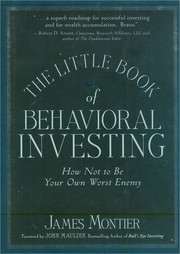
The Little Book of Behavioral Investing

The Little Book of Behavioral Investing

James Montier
2010
T3 236 pages · about 3h 56m to read Open Librarygoodreads

Practical countermeasures rather than a catalogue of biases.

Summary

Montier, a strategist who has worked at Dresdner Kleinwort, Societe Generale and GMO, condensed the behavioural finance literature into short chapters aimed at practitioners. Each chapter names a bias, cites the underlying experiment or market study, and proposes a change to investment process.

The biases covered include overoptimism, illusion of control, overconfidence in forecasts, confirmation bias, conservatism in updating, anchoring, the tendency to act under stress, herding, loss aversion and the sunk cost effect. Montier's practical recommendations follow a single principle: since biases cannot be reasoned away in the moment, investors should change their process in advance. He argues for pre-committed buy and sell criteria written when unemotional, for checklists, for reading company accounts before reading the story, for ignoring macroeconomic forecasts entirely, and for deliberately seeking evidence that contradicts an existing position.

His strongest empirical claims concern forecasting. He presents data showing that analyst earnings forecasts and economist growth forecasts have close to no predictive value, and that both groups adjust after events rather than before them.

The book repeats material from Montier's research notes and from Behavioural Investing, his longer academic-facing volume. It is thin on the question of whether knowing about a bias reduces it, and the replication problems that have hit parts of social psychology since 2011 touch some of the studies he cites, though the finance-specific findings on forecasting and overconfidence have held up better.

Key takeaways 7

  1. Analyst and economist forecasts have essentially no predictive value, so any process depending on them is unsound.
  2. Biases cannot be corrected by awareness in the moment, so investors must pre-commit to rules while calm.
  3. Investors should read a company's financial statements before reading its narrative, because the story anchors the numbers.
  4. Doing nothing is usually the correct action, and the pressure to act destroys returns.
  5. Overconfidence rises with the amount of information collected while accuracy does not.
  6. A written checklist reduces error more effectively than experience or intelligence.
  7. Investors should decide in advance what evidence would prove them wrong and then look for it.

Who should read it

Investors and analysts who want behavioural findings translated into specific process rules they can put in place before the next drawdown.

Who recommended it 1 · 1 direct

Similar books 6

Chosen by shared topics, the entries that hold them, and the people who recommended both.

Charlie Munger · 2005

Speeches making the case for a latticework of mental models from many fields.

“…books I've recommended, highlighted to death, or forced on friends.” — Andrew Wilkinson

Source: Andrew Wilkinson's Bookshelf, neverenough.com

Recommended by: Andrew Wilkinson, Charlie Munger and 26 others
David Dreman · 1999

Data showing that low-expectation stocks beat popular ones over the long run.

“all these people really were helpful in forming and getting me involved in investing” — Joel Greenblatt

Source: Masters in Business transcript: Joel Greenblatt (2018)

Recommended by: Joel Greenblatt, Mohnish Pabrai and 1 other
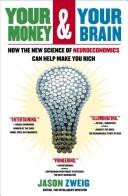
Jason Zweig · 2007

Neuroscience of investing decisions, written by Graham's modern editor.

Recommended by: Mohnish Pabrai
Michael M. Pompian · 2012

Classifies investors into behavioural types for advice and design.

Where it sits in the reference 2

Investment philosophy
Mental models

Topics

InvestingPsychology and BehaviourBehavioural finance and the psychology of money