Updates

  1. Person pages list letters, writing, profiles and links as sortable tables with filters, and show each person's companies as links; Fund letters show each letter's description in its own column.
  2. Experts show a checked job title and a short description of each person; 30 more people have photographs.
  3. Every company, fund, university and publication the experts work for has a page listing the people there.
  4. Fund letters show each letter's thesis and filter by it; 225 person pages list the essays, columns and newsletter issues the person wrote.
  5. Person pages list every essay and newsletter issue a person wrote, and their own books as a table in List view.
  6. Recommends shows the five largest kinds of book and the rest under More; browse pictures load sooner.
  7. Podcasts and talks link the original episode, filter by Audio and video or Press, and list each publisher once.
  8. Pages are wider, Recommends has List and Grid, and a filter clicked again turns off.
  9. Book cards sit in a ruled grid with Open Library and Goodreads links and each book's one-line note.
  10. Funds is now Investors; each investor's styles are buttons that filter the table.
  11. Podcasts and talks on a person's page filter by year and publisher and show as a list or a grid of pictures.
  12. Quotes show only people's own words: 472 summaries written by list sites are gone.
  13. Country pages open from Browse again, and every link on the shelf lands on a page.
  14. Subject and person pages show their sections as tabs, and each book appears once on a person's page.
  15. Book cards show the quote, who said it and the source; grids show five cards to a row.
  16. On a phone, a menu holds the sections, search, Updates, Feedback and dark mode.
  17. Feedback takes a screenshot of the page with no browser prompt, opens a screenshot full size when you click it, and clears itself once sent.
  18. Book cards are centred, search names the topic each book sits in, and any text cut short shows whole on hover.
  19. Search groups its results by kind: people, companies, geographies, subjects, topics, books, funds, fund letters and papers.
  20. The Books table lists who recommended each book by name, and the browser tab names the section you are in.
  21. Feedback can take a screenshot of the page, or one you paste or choose, and opens in the corner beside Updates.
  22. Each rail button reopens its section where you left it, and Browse, Table and People show on every book and subject page.
  23. Filters grey out choices that hold nothing instead of hiding them, and Books › People filters by authors or recommenders.
  24. Feedback takes a subject line and up to three screenshots.
  25. Biographies are grouped by the person they are about: 41 new pages, from Abraham Lincoln to Lee Kuan Yew.
  26. Sport splits into 23 sports, and Religion into one topic per faith.
  27. Book lists show as cards: the cover, one recommendation quote and every recommender by name.
  28. Seventeen subjects that had two or three pages under different names now have one page each.
  29. Every page lists its Experts as authors and recommenders, with a link to them on the Experts tab.
  30. Economics, Financial history, Financial panics and Accounting are subjects of their own, with one page per financial crisis.
  31. Book, person and subject pages open inside the app, so the tabs stay in view.
  32. 996 more book covers, and photographs or logos for 227 more people and companies.
  33. Books › Browse shows every subject as cards, and the rail holds Fund letters, Papers, Experts, Books and Funds.
  34. Every topic over 150 books splits into narrower topics, each with a page of its own.

Send feedback

What is it?
Screenshots, up to 3 (optional)
or paste one with Ctrl+V

We use your email only to reply to you.

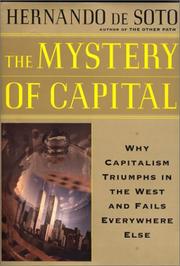
The Mystery of Capital

The Mystery of Capital

Hernando de Soto
2000
T1 288 pages · about 4h 48m to read Open Librarygoodreads

Generalises the Peruvian findings into a theory of dead capital and titling.

Summary

De Soto asks why capitalism produces prosperity in the West and in a few other places while failing elsewhere, and answers that the difference lies in property records. He argues that poor people in developing countries are not poor in assets. They hold houses, farms and businesses worth, by his teams' estimates, many trillions of dollars. What they lack is legal title recorded in a system that strangers can verify.

The consequence, in his account, is that these assets cannot be pledged as collateral, sold to people outside a local network, divided into shares, or used to establish creditworthiness. He calls the assets dead capital. Formal property, by contrast, does more than record ownership: it fixes the economic potential of an asset in a form that can be transferred and combined.

The evidence comes from field surveys by his Institute for Liberty and Democracy in Peru, Egypt, the Philippines and Haiti. His teams counted extralegal dwellings and enterprises, valued them, and timed the bureaucratic process of formalisation, famously finding that legally registering a small business in Lima took 289 days. He also argues from American nineteenth-century history that the United States solved the same problem by recognising squatters' claims rather than by enforcing existing law.

The titling prescription has not performed as promised. Randomised and quasi-experimental studies of titling programmes in Peru, Argentina and Africa have generally found improvements in tenure security and investment in the home but little increase in formal credit, because banks will not lend against property they cannot easily foreclose or resell. Critics including Timothy Mitchell also dispute his measurement of dead capital and argue that formal title can dispossess as easily as it enriches.

Key takeaways 7

  1. The poor in developing countries hold enormous asset value that is invisible to formal legal and financial systems.
  2. Property records matter because they let strangers verify ownership, not because they protect owners from theft.
  3. Assets without recorded title cannot serve as collateral, so they cannot be converted into investable capital.
  4. The cost of formalising a small business in many countries is measured in years of bureaucratic steps, which drives people into the extralegal sector.
  5. Extralegal sectors have their own functioning property conventions, and formal law should be built to recognise them rather than replace them.
  6. The United States resolved the same problem in the nineteenth century by legalising squatters rather than evicting them.
  7. A single national property registry is worth more than the sum of local records because it enables transactions across social networks.

Who should read it

Investors and operators in emerging markets who need to understand why informal sectors persist and why collateral-based lending fails there.

Who recommended it 2 · 1 direct

Similar books 6

Chosen by shared topics, the entries that hold them, and the people who recommended both.
Ha-Joon Chang · 2007

Rich countries urge poor ones to adopt the opposite of the policies they once used.
Macartan Humphreys, Jeffrey D. Sachs, Joseph E. Stiglitz · 2007

Norway is the counterexample the whole volume is arranged around.

Paul Collier · 2007

Why about sixty poor countries are stuck, caught in traps such as conflict.

Ruchir Sharma · 2016

Ten rules for judging whether a country's economy will rise or fall.

Recommended by: Patrick Collison
Michael Pettis · 2001

Emerging-market crises come from the structure of national balance sheets.

Where it sits in the reference 2

Geographies
Economics

Topics

EconomicsPolitics and GovernmentGlobalisation, development and offshore money