Updates

  1. Person pages list letters, writing, profiles and links as sortable tables with filters, and show each person's companies as links; Fund letters show each letter's description in its own column.
  2. Experts show a checked job title and a short description of each person; 30 more people have photographs.
  3. Every company, fund, university and publication the experts work for has a page listing the people there.
  4. Fund letters show each letter's thesis and filter by it; 225 person pages list the essays, columns and newsletter issues the person wrote.
  5. Person pages list every essay and newsletter issue a person wrote, and their own books as a table in List view.
  6. Recommends shows the five largest kinds of book and the rest under More; browse pictures load sooner.
  7. Podcasts and talks link the original episode, filter by Audio and video or Press, and list each publisher once.
  8. Pages are wider, Recommends has List and Grid, and a filter clicked again turns off.
  9. Book cards sit in a ruled grid with Open Library and Goodreads links and each book's one-line note.
  10. Funds is now Investors; each investor's styles are buttons that filter the table.
  11. Podcasts and talks on a person's page filter by year and publisher and show as a list or a grid of pictures.
  12. Quotes show only people's own words: 472 summaries written by list sites are gone.
  13. Country pages open from Browse again, and every link on the shelf lands on a page.
  14. Subject and person pages show their sections as tabs, and each book appears once on a person's page.
  15. Book cards show the quote, who said it and the source; grids show five cards to a row.
  16. On a phone, a menu holds the sections, search, Updates, Feedback and dark mode.
  17. Feedback takes a screenshot of the page with no browser prompt, opens a screenshot full size when you click it, and clears itself once sent.
  18. Book cards are centred, search names the topic each book sits in, and any text cut short shows whole on hover.
  19. Search groups its results by kind: people, companies, geographies, subjects, topics, books, funds, fund letters and papers.
  20. The Books table lists who recommended each book by name, and the browser tab names the section you are in.
  21. Feedback can take a screenshot of the page, or one you paste or choose, and opens in the corner beside Updates.
  22. Each rail button reopens its section where you left it, and Browse, Table and People show on every book and subject page.
  23. Filters grey out choices that hold nothing instead of hiding them, and Books › People filters by authors or recommenders.
  24. Feedback takes a subject line and up to three screenshots.
  25. Biographies are grouped by the person they are about: 41 new pages, from Abraham Lincoln to Lee Kuan Yew.
  26. Sport splits into 23 sports, and Religion into one topic per faith.
  27. Book lists show as cards: the cover, one recommendation quote and every recommender by name.
  28. Seventeen subjects that had two or three pages under different names now have one page each.
  29. Every page lists its Experts as authors and recommenders, with a link to them on the Experts tab.
  30. Economics, Financial history, Financial panics and Accounting are subjects of their own, with one page per financial crisis.
  31. Book, person and subject pages open inside the app, so the tabs stay in view.
  32. 996 more book covers, and photographs or logos for 227 more people and companies.
  33. Books › Browse shows every subject as cards, and the rail holds Fund letters, Papers, Experts, Books and Funds.
  34. Every topic over 150 books splits into narrower topics, each with a page of its own.

Send feedback

What is it?
Screenshots, up to 3 (optional)
or paste one with Ctrl+V

We use your email only to reply to you.

The Bottom Billion

The Bottom Billion

Paul Collier
2007
T2 209 pages · about 3h 29m to read Open Librarygoodreads

The four traps framework; the most cited analytic account of why growth fails to start.

Summary

Paul Collier, an Oxford development economist and former World Bank research director, argues that the development problem is no longer about poor countries generally. Most of the developing world has been converging on rich-country incomes; roughly a billion people live in about sixty countries that have not, and those countries are the actual problem.

His explanation is four traps, each supported by his own econometric work. The conflict trap: civil war destroys income and low income raises the probability of civil war, producing a cycle, and post-conflict countries have high relapse rates. The natural resource trap: resource revenues undermine governance, distort the exchange rate against other exports, and raise the value of capturing the state. The trap of being landlocked with bad neighbours: a landlocked country's growth depends on its neighbours' infrastructure and policy, which it cannot control. The trap of bad governance in a small country: reform requires a critical mass of educated people and a scale of market that small failing states lack.

His policy proposals go beyond aid: military intervention under specified conditions, international charters governing resource revenue, budget transparency and post-conflict conduct, trade preferences designed to help these countries specifically, and better-targeted aid. The book is written for a general audience and states its findings more confidently than the underlying econometrics support; Collier's methods have been criticised, particularly the identification in the conflict work. The framing of a distinct bottom group with specific structural problems has been widely adopted.

Key takeaways 7

  1. Most developing countries have been converging on rich-country incomes, and the development problem concerns the roughly sixty that have not.
  2. Civil war and low income cause each other, and post-conflict countries relapse at high rates.
  3. Resource revenues undermine governance and distort exchange rates against other exports, which is why resource-rich countries frequently grow slowly.
  4. Landlocked countries with poorly governed neighbours depend on infrastructure and policy they cannot influence.
  5. Small failing states lack the educated population and market scale that reform requires.
  6. Collier argues for instruments beyond aid, including conditional military intervention and international charters on resource revenue and budget transparency.
  7. Trade preferences designed for developing countries generally do not help the bottom group, which needs preferences targeted at it specifically.

Who should read it

Investors and policymakers working in frontier markets who want a structural diagnosis of why a specific group of countries has not converged.

Similar books 6

Chosen by shared topics, the entries that hold them, and the people who recommended both.
Dambisa Moyo · 2009

Polemical, but the case for bond-market financing over aid is argued in investor terms.
Morten Jerven · 2013

Ghana's 2010 GDP rebasing is the central case; read before trusting any African macro series.

Recommended by: Bill Gates
Ha-Joon Chang · 2007

Rich countries urge poor ones to adopt the opposite of the policies they once used.
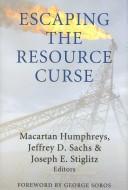
Macartan Humphreys, Jeffrey D. Sachs, Joseph E. Stiglitz · 2007

Norway is the counterexample the whole volume is arranged around.

Hernando de Soto · 2000

The poor hold assets but lack the property records that turn them into capital.

Where it sits in the reference 2

Geographies
Economics

Topics

EconomicsPolitics and GovernmentGlobalisation, development and offshore money