Updates

  1. Person pages list letters, writing, profiles and links as sortable tables with filters, and show each person's companies as links; Fund letters show each letter's description in its own column.
  2. Experts show a checked job title and a short description of each person; 30 more people have photographs.
  3. Every company, fund, university and publication the experts work for has a page listing the people there.
  4. Fund letters show each letter's thesis and filter by it; 225 person pages list the essays, columns and newsletter issues the person wrote.
  5. Person pages list every essay and newsletter issue a person wrote, and their own books as a table in List view.
  6. Recommends shows the five largest kinds of book and the rest under More; browse pictures load sooner.
  7. Podcasts and talks link the original episode, filter by Audio and video or Press, and list each publisher once.
  8. Pages are wider, Recommends has List and Grid, and a filter clicked again turns off.
  9. Book cards sit in a ruled grid with Open Library and Goodreads links and each book's one-line note.
  10. Funds is now Investors; each investor's styles are buttons that filter the table.
  11. Podcasts and talks on a person's page filter by year and publisher and show as a list or a grid of pictures.
  12. Quotes show only people's own words: 472 summaries written by list sites are gone.
  13. Country pages open from Browse again, and every link on the shelf lands on a page.
  14. Subject and person pages show their sections as tabs, and each book appears once on a person's page.
  15. Book cards show the quote, who said it and the source; grids show five cards to a row.
  16. On a phone, a menu holds the sections, search, Updates, Feedback and dark mode.
  17. Feedback takes a screenshot of the page with no browser prompt, opens a screenshot full size when you click it, and clears itself once sent.
  18. Book cards are centred, search names the topic each book sits in, and any text cut short shows whole on hover.
  19. Search groups its results by kind: people, companies, geographies, subjects, topics, books, funds, fund letters and papers.
  20. The Books table lists who recommended each book by name, and the browser tab names the section you are in.
  21. Feedback can take a screenshot of the page, or one you paste or choose, and opens in the corner beside Updates.
  22. Each rail button reopens its section where you left it, and Browse, Table and People show on every book and subject page.
  23. Filters grey out choices that hold nothing instead of hiding them, and Books › People filters by authors or recommenders.
  24. Feedback takes a subject line and up to three screenshots.
  25. Biographies are grouped by the person they are about: 41 new pages, from Abraham Lincoln to Lee Kuan Yew.
  26. Sport splits into 23 sports, and Religion into one topic per faith.
  27. Book lists show as cards: the cover, one recommendation quote and every recommender by name.
  28. Seventeen subjects that had two or three pages under different names now have one page each.
  29. Every page lists its Experts as authors and recommenders, with a link to them on the Experts tab.
  30. Economics, Financial history, Financial panics and Accounting are subjects of their own, with one page per financial crisis.
  31. Book, person and subject pages open inside the app, so the tabs stay in view.
  32. 996 more book covers, and photographs or logos for 227 more people and companies.
  33. Books › Browse shows every subject as cards, and the rail holds Fund letters, Papers, Experts, Books and Funds.
  34. Every topic over 150 books splits into narrower topics, each with a page of its own.

Send feedback

What is it?
Screenshots, up to 3 (optional)
or paste one with Ctrl+V

We use your email only to reply to you.

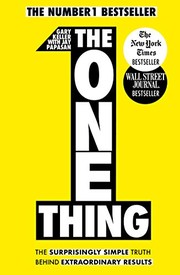
The ONE Thing

The ONE Thing

Gary Keller, Jay Papasan
2001
T4 296 pages · about 4h 56m to read Open Librarygoodreads

Summary

Keller, who founded Keller Williams Realty, and Papasan argue that extraordinary results come from narrowing focus rather than from managing many priorities. Their central device is what they call the focusing question: what is the one thing I can do such that by doing it everything else will be easier or unnecessary. The question is applied at every timescale, from the one thing for a life, to the year, month, week, day and current hour, with each level derived from the one above it. They call this the goal setting to the now sequence.

The first half attacks six beliefs they consider destructive: that everything matters equally, that multitasking is possible, that success requires a disciplined life rather than a small number of habits, that willpower is always available, that balanced living is achievable, and that big is bad. Their treatment of willpower as a depleting resource rests on ego depletion research that has largely failed to replicate. Their treatment of multitasking as costly switching is better supported.

The practical content includes time blocking, in which the one thing receives a protected block of four hours at the start of each day before anything else, protecting that block aggressively, and the argument that habits require roughly sixty-six days rather than twenty-one.

The book is repetitive and the material would fit in a long essay. The evidence is thin and several supporting claims are inaccurate, including a misattributed Pareto history. The focusing question itself is genuinely useful, and the discipline of deriving each timescale's priority from the one above it is the part that distinguishes this from other prioritisation advice.

Key takeaways 8

  1. Extraordinary results follow from narrowing to a single priority rather than from managing many, because effort distributed produces no disproportionate outcome.
  2. The focusing question asks what one action would make everything else easier or unnecessary, which is a stronger test than asking what is most important.
  3. Priorities at every timescale should be derived from the level above, so the day's one thing follows from the month's and the month's from the year's.
  4. Multitasking is task switching with a cost each time, and the cost is invisible to the person paying it.
  5. The single priority should receive a protected block of hours at the start of the day, before anything else is permitted to intervene.
  6. Achieving something significant requires accepting that other areas will be out of balance during that period.
  7. A small number of established habits removes the need for continuous discipline, because the behaviour no longer requires a decision.
  8. The book's claims about willpower depletion rest on research that has largely failed to replicate.

Who should read it

Operators who habitually work from long priority lists and need a single question to force selection, tolerating a repetitive and thinly evidenced book.

Who recommended it 6 · 1 direct

Nate O'Brienreported

Similar books 6

Chosen by shared topics, the entries that hold them, and the people who recommended both.
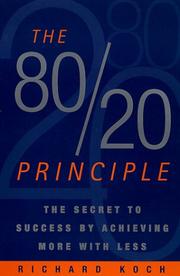
Richard Koch · 1999

Get more with less by finding the 20% of effort that yields 80% of results.

Seth Godin · 1960

Valuable work now needs people who do what can't be written into a job description.

T4 QBQ!
John G. Miller · 2001

Recommended by: The Barefoot Investor

Where it sits in the reference 2

Business themes
Business themes

Topics

Productivity and HabitsBusiness and ManagementTime management and focus