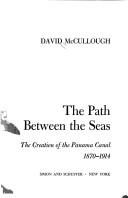
The Path Between the Seas
The building of the Panama Canal, from France's failed attempt to US completion.
The Panama Canal: chokepoint economics and what building one costs.
Summary
McCullough tells the history of the Panama Canal across nearly half a century, from France's attempt in pursuit of national glory to its completion by the United States on the eve of the First World War. Apart from the great wars it was the largest and costliest single effort ever mounted, and it affected tens of thousands of lives. Out of it came a revolution, the birth of Panama as a nation, the conquest of yellow fever and the expansion of American power.
The account draws on previously unpublished sources, interviews with participants and their families, and material gathered in Paris, Bogotá, Panama, the Canal Zone and Washington. Its cast includes Ferdinand de Lesseps and his son Charles, trying to repeat the Suez triumph; Gustave Eiffel; Philippe Bunau-Varilla, "the man who invented Panama"; Dr William Gorgas; the engineer John Stevens; Colonel George Washington Goethals; and Theodore Roosevelt, who took Panama in 1903. McCullough tells the story from many viewpoints, following people who won fame and fortune from the project and others whose reputations and lives it destroyed.
Key takeaways 4
- The French attempt under de Lesseps failed even though he had built the Suez Canal.
- The conquest of yellow fever was one of the project's lasting results.
- Roosevelt took Panama in 1903, and the canal's politics produced a revolution and a new nation.
- The canal was the largest and costliest single project of its era outside wartime.
Who should read it
Readers interested in large infrastructure projects and trade chokepoints, and in how engineering, disease and politics decide whether such a project succeeds.
Who recommended it 3 · 1 direct
“I read this to prepare for a family vacation to Panama. It's pure McCullough: epic drama, political intrigue, heartbreaking defeats, and eventual triumph.”
Similar books 6
Chosen by shared topics, the entries that hold them, and the people who recommended both.
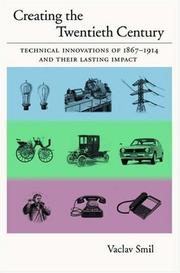
How inventions of 1867 to 1914, from electricity to cars, made the modern world.
“My favorite Smil book, Creating the Twentieth Century (and its companion, Transforming the Twentieth Century) chronicles the inventions of the last 150 years.” — Bill Gates
Source: Vaclav Smil on how energy makes life possible — Gates Notes
Recommended by: Bill Gates, Mohnish Pabrai, Li Lu
The men behind the steam engine, the machine that drove the Industrial Revolution.
Recommended by: Bill Gates, Mohnish Pabrai, Nick Szabo
One USB charger followed from a factory in Vietnam by ship and truck to a door.
Recommended by: Tobi Lütke
Six innovations, from refrigeration to clocks and lenses, that made modern life.
“I really enjoyed Steven Johnson's How We Got To Now. I read a lot of history and science books, but this book stood out because 1) the anecdotes were entertaining and relevant, and 2) it got the process of innovation right.” — Chris Dixon
Source: How We Got To Now — cdixon
Recommended by: Chris Dixon, Mohnish Pabrai
A history of human invention, and a corrective to the hype around innovation.
Recommended by: Bill Gates
Nineteenth-century cases of technological change and how society reacted to it.
Recommended by: Patrick Collison, Marc Andreessen