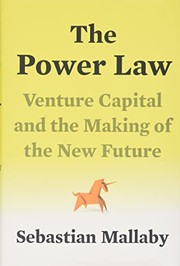
The Power Law: Venture Capital and the Making of the New Future
Venture capital from Arthur Rock to SoftBank, and why a few big bets pay for all.
title confirmed on his CFR expert page
Summary
Mallaby writes the history of venture capital from Arthur Rock and Fairchild Semiconductor through Kleiner Perkins, Sequoia, Accel, Benchmark, Andreessen Horowitz, Tiger Global and SoftBank. He had access to partnership records and to many of the principals.
The organising argument is that venture returns follow a power law, in which a small number of investments produce nearly all the returns, and that this shapes everything about how the business is conducted: why investors seek companies that could be enormous rather than companies likely to succeed, why they accept high failure rates, why they concentrate follow-on capital, and why the discipline resists the diversification logic that governs other asset classes.
Mallaby also argues against the view that venture capitalists merely select winners, holding that they shape outcomes through recruiting executives, forcing strategy changes and providing network access, and he gives cases including the installation of professional management at multiple companies. His account of the Benchmark and Uber conflict, and of SoftBank's Vision Fund distorting late-stage pricing, are the most current sections. The international material covers the transplantation of the model to China, including Sequoia China and the differences in how the industry developed there.
Mallaby is broadly sympathetic to the industry and the book gives less weight to the failures, to the returns of the median fund, which are poor, and to the industry's concentration and exclusion problems, which he covers but does not press. The power law thesis is well supported. The claim that venture capitalists add value beyond selection is harder to establish and Mallaby argues it more than he demonstrates it.
Key takeaways 8
- Venture returns follow a power law in which a small number of investments produce nearly all the profit, which makes seeking outliers rather than avoiding losses the correct strategy.
- The power law explains why venture investors pursue companies with enormous potential rather than companies with a high probability of modest success.
- Median venture funds perform poorly, and the industry's aggregate reputation rests on a small number of firms with persistent access to the best opportunities.
- Venture firms shape outcomes actively through recruiting, strategy intervention and network access rather than only selecting among existing companies.
- Access to the best deals is self-reinforcing, since a firm's record attracts the founders whose companies produce the next record.
- Late-stage capital at the scale SoftBank deployed distorted pricing and removed the discipline that staged financing provides.
- Staged financing, with capital released on milestones, is the industry's core risk control and giving it up changes the incentives for founders.
- The model transferred to China with modifications, and the differences in state involvement and exit routes changed how the industry developed there.
Who should read it
Investors and founders who want the history and the economics of venture capital, particularly why the power law dictates the industry's behaviour.
About Sebastian Mallaby
Paul A. Volcker Senior Fellow for International Economics, Council on Foreign Relations; former Washington Post columnist and Economist correspondent
More Money Than God and The Power Law are the standard narrative histories of hedge funds and venture capital, cited far outside journalism.
Who recommended it 6 · 1 direct
Similar books 6
Chosen by shared topics, the entries that hold them, and the people who recommended both.
Why startups should build something new and own a small market before growing.
“Inspired by modern tech classics like Zero to One and The Hard Thing About Hard Things, I wrote the book to be succinct, thorough, and accessible.” — Chris Dixon
Source: I wrote a book: Read Write Own — cdixon
Recommended by: Balaji S. Srinivasan, Chris Dixon and 38 others
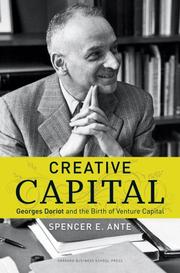
Georges Doriot, who showed that investing in small, risky firms could pay.
“For a biography of Georges Doriot, see Spencer E. Ante, Creative Capital: Georges Doriot and the Birth of Venture Capital (Boston, MA: Harvard Business Press, 2008)” — Michael Mauboussin
Source: Public to Private Equity in the United States: A Long-Term Look, page 63
Recommended by: Michael Mauboussin, Patrick Collison
Why neoliberal capitalism is failing, and the Dynamic Capitalism taking its place.
Recommended by: Brad Feld
How startups raise money from corporate venture arms, from 100-plus interviews.
Recommended by: Cynthia Johnson
Recommended by: Mohnish Pabrai
Where it sits in the reference 4
Topics 4
As an Amazon Associate I earn from qualifying purchases.