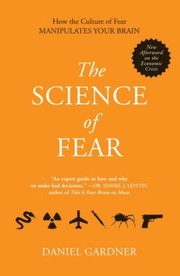
The Science of Fear
Why people fear the wrong things, from the psychology of risk.
Why people misjudge risk; the availability heuristic in public life
Summary
Gardner, a journalist, examines why people fear the wrong things, working from the psychology of risk perception and from data on actual hazard rates. His organising framework is the dual-process model, which he presents as Gut and Head, and the specific heuristics that make Gut systematically wrong about probability.
The mechanisms he covers are availability, where events that come easily to mind are judged more probable; the anchoring and representativeness effects; the affect heuristic, where a felt reaction determines a probability judgement rather than following from one; and the rule of typical things, where an event is judged by how well it matches a mental prototype. He then examines the institutions that exploit these: news media that select for the vivid and rare, advocacy organisations that need fear to raise money, politicians who gain from threat, and industries that sell protection.
The applications include terrorism, where he documents the additional road deaths caused by Americans driving instead of flying after 2001; crime, where perception has diverged from falling rates for decades; chemical and cancer risk; and child abduction, where the gap between perceived and actual rates has changed how children are raised.
The book is well written and the data is handled carefully. It is from 2008 and several of the psychology studies it cites come from the period whose replication record is poor, though the core availability and affect findings have held up better than most. The argument is not original to Gardner, who draws on Slovic, Kahneman, Gigerenzer and Ropeik, and its contribution is assembly and reporting.
Key takeaways 7
- People judge probability by how easily an example comes to mind, which means vivid rare events are systematically overestimated.
- Media selection for the unusual makes the availability heuristic worse, since the events that get reported are precisely the ones that are rare.
- Americans driving instead of flying after 2001 produced a measurable increase in road deaths that exceeded the deaths in the attacks that caused the behaviour change.
- A felt emotional reaction to a hazard determines the probability people assign to it rather than following from an assessment of that probability.
- Advocacy organisations, politicians and security industries each have institutional incentives to amplify fear, and their interests align regardless of coordination.
- Crime rates fell for decades while public perception of crime did not, which shows perception tracks coverage rather than incidence.
- People fear novel and unfamiliar hazards far more than familiar ones with much higher actual mortality, which explains the pattern of public risk concern.
Who should read it
Investors and operators who want a practical account of how risk perception diverges from measured hazard, and who profits from the gap.
Who recommended it 1 · 1 direct
Similar books 6
Chosen by shared topics, the entries that hold them, and the people who recommended both.
Rare, unforeseen, high-impact events drive history, explained only after the fact.
“The Black Swan U The best-known bird around today is The Black Swan, the second book from Nassim Nicolas Taleb.” — Howard Marks
Source: The Complete Collection, page 530
Recommended by: David Perell, Howard Marks, Marc Andreessen and 20 others
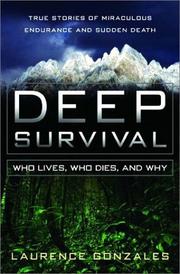
Why some people survive disasters that kill others in the same circumstances.
“Endnotes Laurence Gonzales, Deep Survival: Who Lives, Who Dies, and Why (New York: W.W. Norton & Company, 2003), 119” — Michael Mauboussin
Source: Celebrating the Summit: Making an Informed Decision After a Large Price Gain, page 25
Recommended by: Michael Mauboussin, Patrick O'Shaughnessy
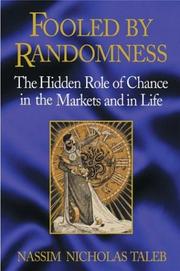
Why people mistake luck for skill, above all in markets.
“Fooled By Randomness was unquestionably the best non-fiction book I read in 2005.” — Brad Feld
Source: Book Review: Fooled By Randomness — Feld Thoughts
Recommended by: Barton Biggs, Brad Feld, Derek Sivers and 15 others
How Daniel Kahneman and Amos Tversky worked together on heuristics and biases.
Recommended by: Andrew Wilkinson, Mohnish Pabrai, Ray Dalio and 6 others
How people learned to measure risk, from early probability to portfolio theory.
“(Risk is the subject of Peter Bernstein’s wonderful new book, Against the Gods: The Remarkable Story of Risk.)” — Bill Miller
Source: 1996 Q3 Market Commentary
Recommended by: Bill Miller, Charles de Vaulx, Howard Marks and 9 others
Ninety-nine cognitive errors in short chapters, each with how to avoid it.
Recommended by: Mohnish Pabrai
Where it sits in the reference 3
Topics 3
As an Amazon Associate I earn from qualifying purchases.