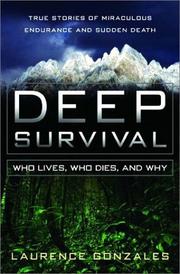
Deep Survival
Why some people survive disasters that kill others in the same circumstances.
Who lives and who dies in extreme situations, and why
Summary
Gonzales examines why some people survive accidents and disasters that kill others in identical circumstances. He works from accident reports, survival case histories in mountaineering, aviation, sailing and wilderness, interviews with survivors, and research on stress physiology and cognition.
His explanation centres on mental models. People build an internal map of a situation and then act on the map rather than on the terrain, and under stress they continue acting on the map after it has stopped matching. He connects this to the physiology: the amygdala responds faster than the neocortex, high stress narrows attention and degrades working memory, and trained responses execute automatically whether or not they fit. The survivors in his cases are the ones who update the model quickly, who accept the new situation without wasting effort on how it should have been, who act on small immediate tasks rather than on the whole problem, and who keep a sense of humour and of purpose.
The practical output is a list of survivor behaviours: perceive and believe, stay calm, think and plan, take correct decisive action, celebrate small successes, count your blessings, play, see the beauty, believe you will succeed, surrender to the possibility of death, do whatever is necessary, and never give up. Gonzales writes as an essayist and the science is presented loosely, with the neuroscience simplified and some of the stress research now dated. The case histories are the strongest part, and the general lesson about updating a model under pressure transfers directly to decision-making outside physical danger.
Key takeaways 7
- People act on their mental model of a situation rather than on the situation, and disasters follow when they continue acting on a model that has stopped matching.
- Experience becomes dangerous when it produces automatic responses that fit the usual case and not the present one.
- Survivors accept the new reality quickly and stop spending effort on how the situation should have been.
- Under acute stress attention narrows and working memory degrades, so plans must be simple enough to execute in that state.
- Breaking an overwhelming situation into small immediate tasks with visible completion restores the ability to act.
- Equipment, training and physical fitness predict survival less well than the ability to update a mental model does.
- Confidence in one's own competence is a risk factor, because it delays the moment at which a person accepts that the model is wrong.
Who should read it
Decision-makers who want a study of how mental models fail under stress, drawn from physical survival cases but applicable to any high-pressure judgement.
Who recommended it 2 · 2 direct
“Endnotes Laurence Gonzales, Deep Survival: Who Lives, Who Dies, and Why (New York: W.W. Norton & Company, 2003), 119”
Similar books 6
Chosen by shared topics, the entries that hold them, and the people who recommended both.
Why people mistake luck for skill, above all in markets.
“Fooled By Randomness was unquestionably the best non-fiction book I read in 2005.” — Brad Feld
Source: Book Review: Fooled By Randomness — Feld Thoughts
Recommended by: Barton Biggs, Brad Feld, Derek Sivers and 15 others
Why people fear the wrong things, from the psychology of risk.
Recommended by: Morgan Housel
How people learned to measure risk, from early probability to portfolio theory.
“(Risk is the subject of Peter Bernstein’s wonderful new book, Against the Gods: The Remarkable Story of Risk.)” — Bill Miller
Source: 1996 Q3 Market Commentary
Recommended by: Bill Miller, Charles de Vaulx, Howard Marks and 9 others
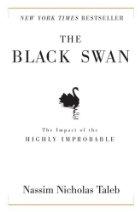
Rare, unforeseen, high-impact events drive history, explained only after the fact.
“The Black Swan U The best-known bird around today is The Black Swan, the second book from Nassim Nicolas Taleb.” — Howard Marks
Source: The Complete Collection, page 530
Recommended by: David Perell, Howard Marks, Marc Andreessen and 20 others
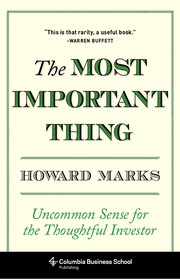
Second-level thinking, risk and market cycles, drawn from Oaktree's client memos.
“This is that rarity, a useful book.” — Warren Buffett
Source: The Most Important Thing — Columbia University Press
Recommended by: Matt Mullenweg, Mohnish Pabrai, Nat Eliason and 3 others

Principles of observation, inference and avoiding error, from the Holmes stories.
Recommended by: Mohnish Pabrai, Patrick O'Shaughnessy and 1 other
Where it sits in the reference 2
Topics 3
As an Amazon Associate I earn from qualifying purchases.