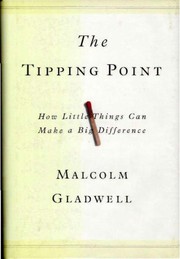
The Tipping Point: How Little Things Can Make a Big Difference
Summary
Gladwell argues that social changes behave like epidemics, spreading through a population until they reach a threshold at which they accelerate rapidly, and identifies three factors that determine whether this occurs.
The law of the few holds that a small number of people with specific characteristics drive most transmission. Connectors know large numbers of people across different social worlds. Mavens accumulate and share information about products and services. Salesmen have unusual persuasive capability. Gladwell uses Paul Revere's ride, contrasted with William Dawes who rode the same night and produced no response, to argue that who carries a message determines whether it spreads.
The stickiness factor holds that the specific content and presentation of a message determines whether it is retained and acted on, illustrated with Sesame Street and Blue's Clues research. The power of context holds that behaviour is far more sensitive to environment than people assume, which he supports with the broken windows theory and the New York crime decline, and with the Stanford prison experiment and the Good Samaritan study.
The evidence has held up poorly. Duncan Watts' research found that influential individuals do not drive cascades and that ordinary people in the right conditions matter more, which directly contradicts the law of the few. The broken windows explanation of the New York crime decline is contested and the crime decline occurred in cities without such policing. The Stanford prison experiment has been substantially discredited. The Good Samaritan study is underpowered. The framework remains widely used in marketing and the underlying research does not support it.
Key takeaways 8
- Social changes spread like epidemics, accelerating rapidly once a threshold of adoption is reached.
- A small number of people with unusual social characteristics carry most transmission, which is the law of the few.
- Connectors, mavens and salesmen play different roles in transmission and are different types of people.
- The specific content and presentation of a message determines whether it is retained, which can be tested and improved.
- Behaviour is far more sensitive to immediate environment than to individual disposition, which is the power of context.
- Group size affects cohesion, and Gladwell cites roughly one hundred and fifty as the limit beyond which groups fragment.
- Subsequent research found that influential individuals do not drive cascades, which directly contradicts the book's central mechanism.
- Several supporting studies including the Stanford prison experiment have since been discredited, and the broken windows explanation is contested.
Who should read it
Readers who want the framework that shaped a generation of marketing thinking, alongside the research that has since contradicted most of it.
Who recommended it 5 · 2 direct
Similar books 6
Chosen by shared topics, the entries that hold them, and the people who recommended both.
Gladwell on underdogs and mistaken assumptions about advantage
“…books I've recommended, highlighted to death, or forced on friends.” — Andrew Wilkinson
Source: Andrew Wilkinson's Bookshelf, neverenough.com
Recommended by: Andrew Wilkinson, Mohnish Pabrai and 1 other

Recommended by: Mohnish Pabrai

How individuals lose judgement in a crowd and how leaders sway crowds.
“The Crowd, written in 1895 by Gustave Le Bon, is probably the most instrumental book in framing my ability to go against the grain of conventional thought and not feel insecure.” — Frank Martin
Source: Martin on the book that let him go against conventional thought
Recommended by: Frank Martin, Mohnish Pabrai, Peter Cundill and 1 other
Recommended by: Mohnish Pabrai
Why mass movements of every kind draw the same frustrated people and use one method.
“My favourite book to recommend is The True Believer: Thoughts on the Nature of Mass Movements by Eric Hoffer. There is no discussion about investing, but it is extremely helpful in understanding…” — Joe Rosenberg
Source: Rosenberg on the book he most often recommends
Recommended by: Joe Rosenberg, Mohnish Pabrai and 6 others

Recommended by: Mohnish Pabrai
Where it sits in the reference 0
No entry holds this book yet. It reached the reference because someone recommended it.
Topics