Updates

  1. Person pages list letters, writing, profiles and links as sortable tables with filters, and show each person's companies as links; Fund letters show each letter's description in its own column.
  2. Experts show a checked job title and a short description of each person; 30 more people have photographs.
  3. Every company, fund, university and publication the experts work for has a page listing the people there.
  4. Fund letters show each letter's thesis and filter by it; 225 person pages list the essays, columns and newsletter issues the person wrote.
  5. Person pages list every essay and newsletter issue a person wrote, and their own books as a table in List view.
  6. Recommends shows the five largest kinds of book and the rest under More; browse pictures load sooner.
  7. Podcasts and talks link the original episode, filter by Audio and video or Press, and list each publisher once.
  8. Pages are wider, Recommends has List and Grid, and a filter clicked again turns off.
  9. Book cards sit in a ruled grid with Open Library and Goodreads links and each book's one-line note.
  10. Funds is now Investors; each investor's styles are buttons that filter the table.
  11. Podcasts and talks on a person's page filter by year and publisher and show as a list or a grid of pictures.
  12. Quotes show only people's own words: 472 summaries written by list sites are gone.
  13. Country pages open from Browse again, and every link on the shelf lands on a page.
  14. Subject and person pages show their sections as tabs, and each book appears once on a person's page.
  15. Book cards show the quote, who said it and the source; grids show five cards to a row.
  16. On a phone, a menu holds the sections, search, Updates, Feedback and dark mode.
  17. Feedback takes a screenshot of the page with no browser prompt, opens a screenshot full size when you click it, and clears itself once sent.
  18. Book cards are centred, search names the topic each book sits in, and any text cut short shows whole on hover.
  19. Search groups its results by kind: people, companies, geographies, subjects, topics, books, funds, fund letters and papers.
  20. The Books table lists who recommended each book by name, and the browser tab names the section you are in.
  21. Feedback can take a screenshot of the page, or one you paste or choose, and opens in the corner beside Updates.
  22. Each rail button reopens its section where you left it, and Browse, Table and People show on every book and subject page.
  23. Filters grey out choices that hold nothing instead of hiding them, and Books › People filters by authors or recommenders.
  24. Feedback takes a subject line and up to three screenshots.
  25. Biographies are grouped by the person they are about: 41 new pages, from Abraham Lincoln to Lee Kuan Yew.
  26. Sport splits into 23 sports, and Religion into one topic per faith.
  27. Book lists show as cards: the cover, one recommendation quote and every recommender by name.
  28. Seventeen subjects that had two or three pages under different names now have one page each.
  29. Every page lists its Experts as authors and recommenders, with a link to them on the Experts tab.
  30. Economics, Financial history, Financial panics and Accounting are subjects of their own, with one page per financial crisis.
  31. Book, person and subject pages open inside the app, so the tabs stay in view.
  32. 996 more book covers, and photographs or logos for 227 more people and companies.
  33. Books › Browse shows every subject as cards, and the rail holds Fund letters, Papers, Experts, Books and Funds.
  34. Every topic over 150 books splits into narrower topics, each with a page of its own.

Send feedback

What is it?
Screenshots, up to 3 (optional)
or paste one with Ctrl+V

We use your email only to reply to you.

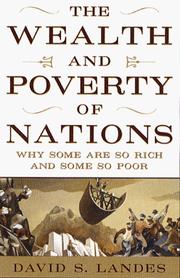
The Wealth and Poverty of Nations

The Wealth and Poverty of Nations

David S. Landes
1998
T1 650 pages · about 10h 50m to read Open Librarygoodreads

Why some economies grew rich; culture and institutions across five centuries

Summary

Landes, an economic historian at Harvard, explains the divergence in national wealth over five hundred years, arguing that culture is the decisive factor while geography, institutions and contingency all contribute. He states directly that if economic history teaches anything, culture makes almost all the difference, which is the book's most quoted and most contested claim.

The argument covers why Europe industrialised rather than China or the Islamic world. He credits European political fragmentation, which prevented any single authority from suppressing innovation; the development of property rights and of contract enforcement; the Christian attitude toward work and toward the manipulation of nature; the independence of intellectual inquiry from religious authority after the Reformation; and the diffusion of technical knowledge through printing.

He contrasts this with Chinese centralisation, which he argues allowed a single decision to terminate maritime exploration, and with Islamic and Iberian trajectories where he argues that religious orthodoxy suppressed inquiry. His treatment of Spain, which received enormous American silver and industrialised late, is used to argue that resources without the appropriate institutions and culture produce nothing.

The cultural argument has drawn heavy criticism as Eurocentric and as close to circular, since culture is inferred partly from the outcomes it is used to explain. Landes gives limited weight to colonial extraction and to the specific advantages Europe obtained from it. Critics including Pomeranz argue that the divergence was later and more contingent than Landes allows. The historical detail is excellent and the causal argument should be read alongside the institutional and geographic accounts it rejects.

Key takeaways 8

  1. Landes argues that culture makes almost all the difference in explaining national wealth, which is the book's central and most contested claim.
  2. European political fragmentation prevented any single authority from suppressing innovation, which he treats as the decisive structural difference from China.
  3. Property rights and enforceable contracts allowed people to invest in outcomes they would capture, which is a precondition for sustained growth.
  4. Chinese centralisation meant a single imperial decision could terminate maritime exploration, which no fragmented system could have imposed.
  5. Spain received enormous quantities of American silver and industrialised late, which shows that resources without appropriate institutions produce nothing.
  6. The independence of intellectual inquiry from religious authority allowed knowledge to accumulate and be applied to production.
  7. Attitudes toward work, time and the manipulation of nature differ across societies and affect economic outcomes over long periods.
  8. The cultural explanation is close to circular, since culture is inferred partly from the outcomes it is invoked to explain.

Who should read it

Readers wanting the cultural explanation of divergence in its strongest form, read against the institutional and geographic accounts it argues with.

Who recommended it 4 · 2 direct

Li Lureported

Similar books 6

Chosen by shared topics, the entries that hold them, and the people who recommended both.
Matt Ridley · 2010

Prosperity grows as trade and specialisation let ideas meet and combine.

“…books I've recommended, highlighted to death, or forced on friends.” — Andrew Wilkinson

Source: Andrew Wilkinson's Bookshelf, neverenough.com

Recommended by: Andrew Wilkinson, Bill Gates, Frank Martin and 10 others
Thomas K. McCraw · 1997

How Britain, Germany, Japan and the US each built their own form of capitalism.

Recommended by: Mohnish Pabrai
Vaclav Smil · 2013

How American manufacturing rose to lead the world, and why its share then fell.

Recommended by: Mohnish Pabrai
Nancy F. Koehn · 1990

Why Britain's empire after the Seven Years War struggled with the costs of power.

Recommended by: Mohnish Pabrai

Where it sits in the reference 3

Assets
Mental models
Economics

Topics

EconomicsGeneral HistoryEconomic and Business History