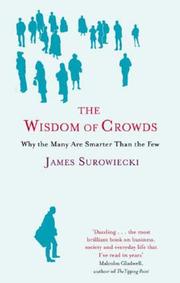
The Wisdom of Crowds: Why the Many Are Smarter Than the Few and How Collective Wisdom Shapes Business, Economies, Societies and Nations
When groups judge better than experts, and the four conditions that make it work.
Summary
Surowiecki argues that aggregated judgments from many people frequently outperform the judgment of experts, and specifies the four conditions required for this to hold: diversity of opinion, meaning members hold different private information; independence, meaning their judgments are not determined by others; decentralisation, meaning they can draw on local and specific knowledge; and aggregation, meaning a mechanism exists for combining the judgments into a collective one.
His opening example is Galton's 1907 observation that the median guess of nearly eight hundred people at a cattle weight was within one pound of the correct figure. He extends this to markets as aggregation mechanisms, to the search for the missing submarine Scorpion, and to prediction markets.
He divides problems into cognition problems with a definite answer, coordination problems where each participant must anticipate others, and cooperation problems requiring self-interested people to work together, and analyses each separately. The second half examines failures. When independence is lost, information cascades produce herding, in which each participant rationally follows the previous ones and the aggregate information disappears. He covers the Columbia shuttle disaster, stock market bubbles and committee dynamics as cases where the conditions failed.
The conditions are the book's contribution, since they specify when crowd judgment works and when it fails, which is the part most often dropped in popular use. The book is journalism rather than research and the cases are selected. The independence condition has become harder to satisfy as social platforms have made judgments visible before they are formed, which strengthens the book's warning rather than its optimism.
Key takeaways 8
- Aggregated judgments from many people can outperform experts, but only when four specific conditions hold.
- The conditions are diversity of private information, independence of judgment, decentralisation permitting local knowledge, and a mechanism for aggregation.
- When independence fails, participants follow each other and the aggregate stops containing any new information.
- Information cascades occur when each participant rationally infers from previous choices, which produces herding without anyone behaving irrationally.
- Adding more informed people to a group can reduce accuracy if it reduces diversity, because correlated errors compound.
- Markets function as aggregation mechanisms and fail when their participants stop forming independent judgments.
- Cognition problems, coordination problems and cooperation problems have different requirements, and the crowd result applies most cleanly to the first.
- Small groups can be worse than individuals, because deliberation produces convergence and amplifies the errors that members share.
Who should read it
Operators designing forecasting and decision processes who need to know when aggregating judgments helps and when it produces correlated error.
Who recommended it 7 · 4 direct
“Mind-blowing examples of how groups of diverse people acting independently are smarter than any one person in the group. Has huge implications for management, markets, decision-making, and more.”
“Incentives Jim Surowiecki deftly articulated this line of thinking in his delightful book, The Wisdom of Crowds.”
Similar books 6
Chosen by shared topics, the entries that hold them, and the people who recommended both.

Why people mistake luck for skill, above all in markets.
“Fooled By Randomness was unquestionably the best non-fiction book I read in 2005.” — Brad Feld
Source: Book Review: Fooled By Randomness — Feld Thoughts
Recommended by: Barton Biggs, Brad Feld, Derek Sivers and 15 others
How people learned to measure risk, from early probability to portfolio theory.
“(Risk is the subject of Peter Bernstein’s wonderful new book, Against the Gods: The Remarkable Story of Risk.)” — Bill Miller
Source: 1996 Q3 Market Commentary
Recommended by: Bill Miller, Charles de Vaulx, Howard Marks and 9 others
How snap judgments work, when to trust them and when they mislead.
“Malcolm Gladwell, Blink: The Power of Thinking Without Thinking (New York: Little, Brown and Company, 2005)” — Michael Mauboussin
Source: Are You an Expert? Experts and Markets, page 9
Recommended by: Michael Mauboussin, Mohnish Pabrai and 2 others
Four traps that ruin decisions, such as narrow framing, and a process to beat each.
“Interesting and insightful dive into the subject of how to make big decisions. Specific useful advice.” — Derek Sivers
Source: Derek Sivers book notes (primary, rated list) · Rating: 8/10
Recommended by: Andrew Wilkinson, Derek Sivers and 6 others
How checklists stop experts in complex fields failing to apply what they know.
“Like Malcom Gladwell, a book that could and should have been an article, but puffed up with 200 pages of supporting stories, mostly great detailed tales of his surgeon experiences where a checklist would have come in handy. Here's the book in one sentence: You should make checklists for any complex procedures or decisions.” — Derek Sivers
Source: Derek Sivers book notes (primary, rated list) · Rating: 3/10
Recommended by: Derek Sivers, Keith Rabois and 10 others
How individuals lose judgement in a crowd and how leaders sway crowds.
Recommended by: Frank Martin, Mohnish Pabrai, Peter Cundill and 1 other
Where it sits in the reference 2
Topics 3
As an Amazon Associate I earn from qualifying purchases.