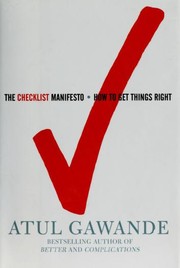
The Checklist Manifesto
How checklists stop experts in complex fields failing to apply what they know.
Summary
Gawande, a surgeon, argues that failures in complex fields come increasingly from the failure to apply knowledge correctly rather than from lacking it, and that checklists address this specific problem. He distinguishes errors of ignorance, where the knowledge does not exist, from errors of ineptitude, where it exists and was not applied.
The evidence he builds on comes from aviation, where checklists were introduced after the 1935 B-17 crash, and from construction, where he examines how large buildings are coordinated through scheduled checks and submittal schedules. The central medical evidence is Peter Pronovost's central line infection checklist at Johns Hopkins, which reduced infection rates to near zero, and the World Health Organization surgical safety checklist that Gawande led, tested across eight hospitals in different countries. That study showed major complications falling by thirty-six percent and deaths by forty-seven percent.
He is specific about checklist design. Good checklists are short, usually five to nine items, focus on the killer items that are commonly missed rather than on every step, specify pause points, and are tested in practice. Read-do and do-confirm are the two formats. He argues that the introduction of a team briefing where everyone states their name and role is one of the most effective components, because it changes whether people speak up later.
The main criticism is that checklists have been applied where they do not fit, and that some replication studies of the surgical checklist, including a large Ontario study, found no effect, which suggests that implementation quality matters more than the instrument. Gawande's argument that professional autonomy resists checklists is well supported, and the resistance he documents applies equally in finance and management.
Key takeaways 8
- Failures in complex fields now come mostly from not applying available knowledge correctly rather than from lacking knowledge.
- A checklist protects against the routine steps that experts skip precisely because they are routine and appear beneath attention.
- Good checklists contain five to nine items covering commonly missed steps, not every step in the process.
- Checklists must specify pause points where the team stops, and must be tested in real use before adoption.
- A team briefing where each person states their name and role measurably increases the likelihood that someone raises a problem later.
- Highly trained professionals resist checklists because the instrument implies their expertise is insufficient, which is the main barrier to adoption.
- Complex systems require distributed authority combined with mandated communication checks, rather than central control of every decision.
- Where checklist studies show no effect, the failure is usually in implementation and team adoption rather than in the instrument.
Who should read it
Operators and investors running processes where expensive mistakes come from skipped known steps, wanting the design rules rather than the general idea.
Who recommended it 12 · 7 direct
“Like Malcom Gladwell, a book that could and should have been an article, but puffed up with 200 pages of supporting stories, mostly great detailed tales of his surgeon experiences where a checklist would have come in handy. Here's the book in one sentence: You should make checklists for any complex procedures or decisions.”
“In his superb book, The Checklist Manifesto, Dr. Atul Gawande describes two types of checklists.2 The first is called DO-CONFIRM.”
“Atul Gawande’s Book “The Checklist Manifesto” – Highly Recommended The only reason why Pabrai Funds use a written checklist for investing is because a person named Dr.”
“A good checklist can change your life, or at least that's what surgeon, writer, and public health researcher Atul Gawande believes. In this book, he gives you the advice you can use to start leveraging checklists to streamline all facets of your life and business (just ask any pilot).”
Similar books 6
Chosen by shared topics, the entries that hold them, and the people who recommended both.
Why some things gain from volatility and disorder, and how to build them.
“Antifragile. Loved the first 1/3 and last 1/3 of this book.” — Andrew Chen
Source: Books I’m reading (2013)
Recommended by: Ana Fabrega, Andrew Chen, Derek Sivers and 24 others
Four traps that ruin decisions, such as narrow framing, and a process to beat each.
“Interesting and insightful dive into the subject of how to make big decisions. Specific useful advice.” — Derek Sivers
Source: Derek Sivers book notes (primary, rated list) · Rating: 8/10
Recommended by: Andrew Wilkinson, Derek Sivers and 6 others

Why people mistake luck for skill, above all in markets.
“Fooled By Randomness was unquestionably the best non-fiction book I read in 2005.” — Brad Feld
Source: Book Review: Fooled By Randomness — Feld Thoughts
Recommended by: Barton Biggs, Brad Feld, Derek Sivers and 15 others
Speeches making the case for a latticework of mental models from many fields.
“…books I've recommended, highlighted to death, or forced on friends.” — Andrew Wilkinson
Source: Andrew Wilkinson's Bookshelf, neverenough.com
Recommended by: Andrew Wilkinson, Charlie Munger and 26 others

Rare, unforeseen, high-impact events drive history, explained only after the fact.
“The Black Swan U The best-known bird around today is The Black Swan, the second book from Nassim Nicolas Taleb.” — Howard Marks
Source: The Complete Collection, page 530
Recommended by: David Perell, Howard Marks, Marc Andreessen and 20 others
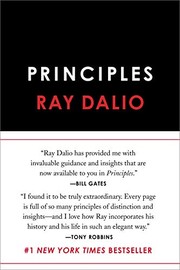
Decision rules from building Bridgewater: radical truth and radical transparency.
“Several people recommended Ray Dalio’s book Principles to me.” — Brad Feld
Source: Book: Principles by Ray Dalio — Feld Thoughts
Recommended by: Alfred Lin, Brad Feld, Derek Sivers and 31 others
Where it sits in the reference 2
Topics 3
As an Amazon Associate I earn from qualifying purchases.