Updates

  1. Person pages list letters, writing, profiles and links as sortable tables with filters, and show each person's companies as links; Fund letters show each letter's description in its own column.
  2. Experts show a checked job title and a short description of each person; 30 more people have photographs.
  3. Every company, fund, university and publication the experts work for has a page listing the people there.
  4. Fund letters show each letter's thesis and filter by it; 225 person pages list the essays, columns and newsletter issues the person wrote.
  5. Person pages list every essay and newsletter issue a person wrote, and their own books as a table in List view.
  6. Recommends shows the five largest kinds of book and the rest under More; browse pictures load sooner.
  7. Podcasts and talks link the original episode, filter by Audio and video or Press, and list each publisher once.
  8. Pages are wider, Recommends has List and Grid, and a filter clicked again turns off.
  9. Book cards sit in a ruled grid with Open Library and Goodreads links and each book's one-line note.
  10. Funds is now Investors; each investor's styles are buttons that filter the table.
  11. Podcasts and talks on a person's page filter by year and publisher and show as a list or a grid of pictures.
  12. Quotes show only people's own words: 472 summaries written by list sites are gone.
  13. Country pages open from Browse again, and every link on the shelf lands on a page.
  14. Subject and person pages show their sections as tabs, and each book appears once on a person's page.
  15. Book cards show the quote, who said it and the source; grids show five cards to a row.
  16. On a phone, a menu holds the sections, search, Updates, Feedback and dark mode.
  17. Feedback takes a screenshot of the page with no browser prompt, opens a screenshot full size when you click it, and clears itself once sent.
  18. Book cards are centred, search names the topic each book sits in, and any text cut short shows whole on hover.
  19. Search groups its results by kind: people, companies, geographies, subjects, topics, books, funds, fund letters and papers.
  20. The Books table lists who recommended each book by name, and the browser tab names the section you are in.
  21. Feedback can take a screenshot of the page, or one you paste or choose, and opens in the corner beside Updates.
  22. Each rail button reopens its section where you left it, and Browse, Table and People show on every book and subject page.
  23. Filters grey out choices that hold nothing instead of hiding them, and Books › People filters by authors or recommenders.
  24. Feedback takes a subject line and up to three screenshots.
  25. Biographies are grouped by the person they are about: 41 new pages, from Abraham Lincoln to Lee Kuan Yew.
  26. Sport splits into 23 sports, and Religion into one topic per faith.
  27. Book lists show as cards: the cover, one recommendation quote and every recommender by name.
  28. Seventeen subjects that had two or three pages under different names now have one page each.
  29. Every page lists its Experts as authors and recommenders, with a link to them on the Experts tab.
  30. Economics, Financial history, Financial panics and Accounting are subjects of their own, with one page per financial crisis.
  31. Book, person and subject pages open inside the app, so the tabs stay in view.
  32. 996 more book covers, and photographs or logos for 227 more people and companies.
  33. Books › Browse shows every subject as cards, and the rail holds Fund letters, Papers, Experts, Books and Funds.
  34. Every topic over 150 books splits into narrower topics, each with a page of its own.

Send feedback

What is it?
Screenshots, up to 3 (optional)
or paste one with Ctrl+V

We use your email only to reply to you.

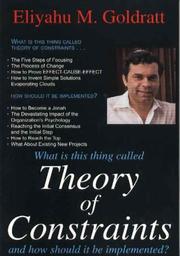
Theory of Constraints

Theory of Constraints

Eliyahu M. Goldratt
1990
T2 161 pages · about 2h 41m to read Open Librarygoodreads

Summary

Goldratt sets out the theory of constraints more formally than in The Goal, presenting it as a general method for improving any system rather than as a manufacturing technique.

The central claim is that every system has at most a small number of constraints limiting its output, that improvement anywhere except at the constraint produces no gain in system output, and that most management effort is therefore wasted. The five focusing steps follow: identify the constraint, decide how to exploit it so that no constraint capacity is wasted, subordinate everything else to that decision, raise the constraint by adding capacity, and then return to the first step because the constraint will have moved.

He also sets out his accounting objection. Cost accounting allocates overhead to units produced and therefore rewards local efficiency, which encourages producing inventory that the constraint cannot process. He proposes throughput accounting instead, measuring throughput, meaning the rate at which the system generates money through sales; inventory, meaning money tied up in things the system intends to sell; and operating expense, meaning money spent converting inventory into throughput.

The book also introduces the thinking processes, being a set of logic tools for identifying root causes and constructing solutions, which Goldratt developed further in later work.

The method has been applied successfully in manufacturing and project environments and the evidence is largely practitioner reports. Goldratt's dismissal of cost accounting is stated more absolutely than the case supports. The core insight about constraints is correct, simple and consistently underapplied.

Key takeaways 7

  1. Every system is limited by a small number of constraints, and improvement anywhere except at the constraint produces no gain in system output.
  2. The constraint's capacity must never be wasted, which means everything else in the system should be subordinated to keeping it working.
  3. Once a constraint's capacity is raised the constraint moves elsewhere, so the improvement process must repeat rather than conclude.
  4. Cost accounting allocates overhead to units produced and therefore rewards local efficiency, which encourages building inventory the constraint cannot process.
  5. Throughput, inventory and operating expense are the three measures that connect local decisions to whether the system makes money.
  6. Local optimisation of every function produces a system that performs worse than one where most functions deliberately run below capacity.
  7. Identifying the constraint is usually easy and is nonetheless skipped, because management attention is allocated by visibility rather than by leverage.

Who should read it

Operators who want the general statement of constraint-based improvement and the accounting argument that supports it.

About Eliyahu M. Goldratt

Israeli physicist and management theorist who created the Theory of Constraints and founded the Avraham Y. Goldratt Institute.

The Goal teaches throughput accounting and constraint management inside a plant-turnaround novel: find the bottleneck, subordinate every other decision to it, raise it, then repeat. The method transfers to any process with a limiting step, which is why operations, project and software-delivery teams still run on it.

Avraham Y. Goldratt Institute

Similar books 6

Chosen by shared topics, the entries that hold them, and the people who recommended both.

Eliyahu M. Goldratt · 1997

A novel applying the theory of constraints to finishing projects on time.
Eliyahu M. Goldratt, Jeff Cox · 1984

A plant manager learns that a system's output is set by its bottleneck.

Eliyahu M. Goldratt · 2008

A dialogue on thinking clearly: reality is simple, conflicts can be resolved.

Recommended by: Mohnish Pabrai
Gene Kim, Kevin Behr, George Spafford · 2013

A novel in which an IT manager rescues a failing project using lessons from The Goal.
Jeremy Hope, Robin Fraser · 2003

Why the annual budget harms firms, and how some run without one.
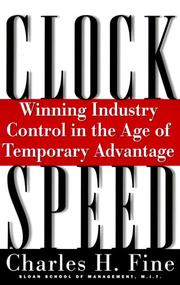
Charles H. Fine · 1998

Fast-moving industries reveal supply-chain dynamics slow ones take decades to show.

Where it sits in the reference 4

Strategists
Business themes
Mental models
Business themes

Topics

Business and Management