Updates

  1. Person pages list letters, writing, profiles and links as sortable tables with filters, and show each person's companies as links; Fund letters show each letter's description in its own column.
  2. Experts show a checked job title and a short description of each person; 30 more people have photographs.
  3. Every company, fund, university and publication the experts work for has a page listing the people there.
  4. Fund letters show each letter's thesis and filter by it; 225 person pages list the essays, columns and newsletter issues the person wrote.
  5. Person pages list every essay and newsletter issue a person wrote, and their own books as a table in List view.
  6. Recommends shows the five largest kinds of book and the rest under More; browse pictures load sooner.
  7. Podcasts and talks link the original episode, filter by Audio and video or Press, and list each publisher once.
  8. Pages are wider, Recommends has List and Grid, and a filter clicked again turns off.
  9. Book cards sit in a ruled grid with Open Library and Goodreads links and each book's one-line note.
  10. Funds is now Investors; each investor's styles are buttons that filter the table.
  11. Podcasts and talks on a person's page filter by year and publisher and show as a list or a grid of pictures.
  12. Quotes show only people's own words: 472 summaries written by list sites are gone.
  13. Country pages open from Browse again, and every link on the shelf lands on a page.
  14. Subject and person pages show their sections as tabs, and each book appears once on a person's page.
  15. Book cards show the quote, who said it and the source; grids show five cards to a row.
  16. On a phone, a menu holds the sections, search, Updates, Feedback and dark mode.
  17. Feedback takes a screenshot of the page with no browser prompt, opens a screenshot full size when you click it, and clears itself once sent.
  18. Book cards are centred, search names the topic each book sits in, and any text cut short shows whole on hover.
  19. Search groups its results by kind: people, companies, geographies, subjects, topics, books, funds, fund letters and papers.
  20. The Books table lists who recommended each book by name, and the browser tab names the section you are in.
  21. Feedback can take a screenshot of the page, or one you paste or choose, and opens in the corner beside Updates.
  22. Each rail button reopens its section where you left it, and Browse, Table and People show on every book and subject page.
  23. Filters grey out choices that hold nothing instead of hiding them, and Books › People filters by authors or recommenders.
  24. Feedback takes a subject line and up to three screenshots.
  25. Biographies are grouped by the person they are about: 41 new pages, from Abraham Lincoln to Lee Kuan Yew.
  26. Sport splits into 23 sports, and Religion into one topic per faith.
  27. Book lists show as cards: the cover, one recommendation quote and every recommender by name.
  28. Seventeen subjects that had two or three pages under different names now have one page each.
  29. Every page lists its Experts as authors and recommenders, with a link to them on the Experts tab.
  30. Economics, Financial history, Financial panics and Accounting are subjects of their own, with one page per financial crisis.
  31. Book, person and subject pages open inside the app, so the tabs stay in view.
  32. 996 more book covers, and photographs or logos for 227 more people and companies.
  33. Books › Browse shows every subject as cards, and the rail holds Fund letters, Papers, Experts, Books and Funds.
  34. Every topic over 150 books splits into narrower topics, each with a page of its own.

Send feedback

What is it?
Screenshots, up to 3 (optional)
or paste one with Ctrl+V

We use your email only to reply to you.

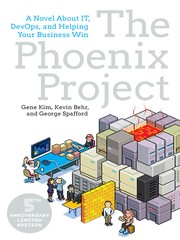
The Phoenix Project

The Phoenix Project

Gene Kim, Kevin Behr, George Spafford
2013
T2 345 pages · about 5h 45m to read Open Librarygoodreads

Summary

Kim, Behr and Spafford wrote a business novel about an information technology organisation in crisis, deliberately modelled on Eliyahu Goldratt's The Goal, which taught manufacturing constraints through fiction.

The narrative follows Bill Palmer, unwillingly promoted to run operations at a struggling manufacturer, as a critical project fails, deployments break production, audit findings accumulate and the business considers outsourcing. He is guided by a board member who teaches him to see technology work through the framework of manufacturing operations.

The framework has two parts. The four types of work are business projects, internal projects, changes and unplanned work, and the authors argue that unplanned work consumes the capacity that the other three need, so reducing it is the first priority. The Three Ways are the underlying principles: the first is optimising the flow of work from development through operations to the customer, which requires seeing the whole system rather than individual departments; the second is amplifying feedback loops so that problems are detected and corrected close to their source; the third is creating a culture of continual experimentation and learning, which requires accepting that failures will occur and treating them as information.

The operational content applies constraint theory directly. Identify the bottleneck, which in the novel is a single overloaded engineer through whom all critical work passes; subordinate everything else to it; protect it from non-essential demand; and then expand it. The authors also argue for small frequent releases over large infrequent ones, for automating deployment, and for making work visible.

The novel form makes the ideas accessible and also makes the characters thin and the resolution implausibly smooth. The technical practices described have become standard since publication, so a reader in a mature engineering organisation will find them familiar. The DevOps Handbook by the same lead author covers the practices directly.

Key takeaways 7

  1. Unplanned work consumes the capacity that planned work requires, so reducing it is the first priority in an overloaded technology organisation.
  2. Technology work divides into business projects, internal projects, changes and unplanned work, and organisations track only the first.
  3. A single overloaded individual through whom critical work passes is a constraint, and no improvement elsewhere increases throughput.
  4. Work in progress must be limited, because starting more work than the constraint can process increases delay without increasing output.
  5. Small frequent releases reduce risk relative to large infrequent ones, because the change being deployed is smaller and easier to reverse.
  6. Feedback loops must detect problems close to their source, since defects found late cost far more to correct.
  7. Making work visible is a precondition for managing it, and most technology organisations cannot see what their people are actually doing.

Who should read it

Executives outside engineering who need to understand why technology delivery fails, and engineering leaders who want a shared vocabulary for constraint-based improvement.

Similar books 6

Chosen by shared topics, the entries that hold them, and the people who recommended both.

Eliyahu M. Goldratt, Jeff Cox · 1984

A plant manager learns that a system's output is set by its bottleneck.

Eliyahu M. Goldratt · 1997

A novel applying the theory of constraints to finishing projects on time.
Eliyahu M. Goldratt · 1990

Every system has one constraint; find it, exploit it, and subordinate all else to it.

Timothy Lister, Tom DeMarco · 1987

Recommended by: Drew Houston, Jeff Atwood

Where it sits in the reference 4

Business themes
Mental models
Business themes
Business themes

Topics

Technology and ComputingBusiness and ManagementFictionBusiness novels and parablesProgramming and computer science