Updates

  1. Person pages list letters, writing, profiles and links as sortable tables with filters, and show each person's companies as links; Fund letters show each letter's description in its own column.
  2. Experts show a checked job title and a short description of each person; 30 more people have photographs.
  3. Every company, fund, university and publication the experts work for has a page listing the people there.
  4. Fund letters show each letter's thesis and filter by it; 225 person pages list the essays, columns and newsletter issues the person wrote.
  5. Person pages list every essay and newsletter issue a person wrote, and their own books as a table in List view.
  6. Recommends shows the five largest kinds of book and the rest under More; browse pictures load sooner.
  7. Podcasts and talks link the original episode, filter by Audio and video or Press, and list each publisher once.
  8. Pages are wider, Recommends has List and Grid, and a filter clicked again turns off.
  9. Book cards sit in a ruled grid with Open Library and Goodreads links and each book's one-line note.
  10. Funds is now Investors; each investor's styles are buttons that filter the table.
  11. Podcasts and talks on a person's page filter by year and publisher and show as a list or a grid of pictures.
  12. Quotes show only people's own words: 472 summaries written by list sites are gone.
  13. Country pages open from Browse again, and every link on the shelf lands on a page.
  14. Subject and person pages show their sections as tabs, and each book appears once on a person's page.
  15. Book cards show the quote, who said it and the source; grids show five cards to a row.
  16. On a phone, a menu holds the sections, search, Updates, Feedback and dark mode.
  17. Feedback takes a screenshot of the page with no browser prompt, opens a screenshot full size when you click it, and clears itself once sent.
  18. Book cards are centred, search names the topic each book sits in, and any text cut short shows whole on hover.
  19. Search groups its results by kind: people, companies, geographies, subjects, topics, books, funds, fund letters and papers.
  20. The Books table lists who recommended each book by name, and the browser tab names the section you are in.
  21. Feedback can take a screenshot of the page, or one you paste or choose, and opens in the corner beside Updates.
  22. Each rail button reopens its section where you left it, and Browse, Table and People show on every book and subject page.
  23. Filters grey out choices that hold nothing instead of hiding them, and Books › People filters by authors or recommenders.
  24. Feedback takes a subject line and up to three screenshots.
  25. Biographies are grouped by the person they are about: 41 new pages, from Abraham Lincoln to Lee Kuan Yew.
  26. Sport splits into 23 sports, and Religion into one topic per faith.
  27. Book lists show as cards: the cover, one recommendation quote and every recommender by name.
  28. Seventeen subjects that had two or three pages under different names now have one page each.
  29. Every page lists its Experts as authors and recommenders, with a link to them on the Experts tab.
  30. Economics, Financial history, Financial panics and Accounting are subjects of their own, with one page per financial crisis.
  31. Book, person and subject pages open inside the app, so the tabs stay in view.
  32. 996 more book covers, and photographs or logos for 227 more people and companies.
  33. Books › Browse shows every subject as cards, and the rail holds Fund letters, Papers, Experts, Books and Funds.
  34. Every topic over 150 books splits into narrower topics, each with a page of its own.

Send feedback

What is it?
Screenshots, up to 3 (optional)
or paste one with Ctrl+V

We use your email only to reply to you.

What Has Worked In Investing

What Has Worked In Investing

Tweedy, Browne Company LLC
T4 no Open Library recordgoodreads

Tweedy Browne survey of empirical studies supporting value factors.

Summary

Tweedy, Browne, a value-oriented investment firm with a history going back to the 1920s and a connection to Benjamin Graham, assembled this compilation of academic and practitioner studies on what characteristics have preceded superior stock returns.

The studies are summarised rather than reproduced, and the compilation organises them by characteristic. The categories include low price relative to book value, low price relative to earnings, low price relative to cash flow, high dividend yield, small market capitalisation, low price relative to historical high, insider purchases, share repurchases, and the combination of several of these. For each the firm summarises the studies, the periods and markets covered, and the measured return differences between the cheapest and most expensive groups.

The compilation is a marketing document for a firm that manages money on these principles, which readers should note. It is also useful precisely because it assembles in one place a body of evidence that is otherwise scattered across journals. Its limitation is that it presents studies without engaging the criticisms, particularly the arguments that the value premium reflects risk rather than mispricing, that data mining across many characteristics produces apparent effects, and that several of the documented premia have weakened substantially since the studies were conducted. It should be read as a bibliography with summaries rather than as an argument.

Key takeaways 7

  1. Stocks priced low relative to book value, earnings and cash flow have historically produced higher returns than expensive ones.
  2. The measured return differences appear across multiple countries and multiple periods, which reduces the likelihood of a single-market artefact.
  3. Small capitalisation stocks produced higher returns than large ones over the periods studied.
  4. Insider purchases and company share repurchases have preceded superior returns in the studies compiled.
  5. Combining several cheapness characteristics produced larger measured differences than any single one.
  6. The compilation is a marketing document for a firm managing money on these principles, which readers should weigh.
  7. It presents studies without engaging the criticisms, including that the premia may reflect risk and that several have weakened since.

Who should read it

Value investors who want the empirical studies on cheapness characteristics assembled in one place, read alongside the criticisms it omits.

Similar books 6

Chosen by shared topics, the entries that hold them, and the people who recommended both.

Tobias E. Carlisle · 2014

Traces the method from Graham through Icahn to the acquirer's multiple.

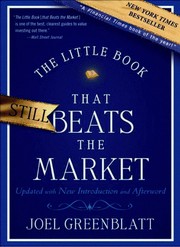
Joel Greenblatt · 2010

The magic formula: buy cheap stocks with high returns on capital, mechanically.

Edward O. Thorp · 2017

From beating blackjack with maths to pricing warrants and running a hedge fund.

Thomas P. Au · 2004

Updates Graham and Dodd's valuation method for modern financial statements

Recommended by: Mohnish Pabrai

Philip L. Carret, Philip Carret · 1995

A fund manager of sixty years on investing, business and a long life.

Recommended by: Mohnish Pabrai

Where it sits in the reference 2

Investment styles
Investment styles

Topics

Investing