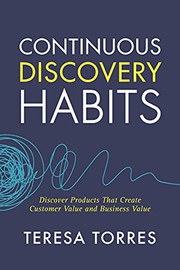
Continuous Discovery Habits
Torres operationalizes what Cagan describes. Weekly customer touchpoints, opportunity-solution trees, assumption testing — this is the most practical account of how discovery actually becomes a habit rather than a quarterly exercise. Pairs directly with Inspired as the how to its what.
Summary
Torres, a product discovery coach, wrote a practical method for how product teams should decide what to build, aimed at replacing occasional research projects with a continuous weekly practice.
Her central structure is the opportunity solution tree. At the top sits a single outcome the team is trying to achieve, expressed as a behaviour change in customers rather than as a business metric or an output. Below it sit opportunities, meaning the customer needs, pain points and desires discovered through interviews, organised into a structure that shows how they relate. Below each opportunity sit candidate solutions. Below each solution sit the assumptions that must hold for it to work, which are what tests are designed against. Torres argues that teams jump from outcome to solution without mapping the opportunity space, which means they compare a solution against nothing rather than against alternatives.
The practices she prescribes are specific. Interview at least one customer every week, conducted by the trio of product manager, designer and engineer together rather than delegated to a researcher. Ask for stories about specific past instances rather than for opinions or generalisations, because people describe what they actually did more accurately than what they generally do. Generate at least three solutions for any opportunity before evaluating any of them. Identify the assumptions behind each solution and test the riskiest first with the smallest possible experiment.
She also covers how to select which opportunity to address, using a structured comparison rather than a scoring formula, and how to avoid the confirmation bias that follows from testing an idea a team is already committed to.
The book is craft advice from practice rather than research, and it is written for software product teams in companies with dedicated product functions. Its interviewing method overlaps with Fitzpatrick's The Mom Test, also in this reference.
Key takeaways 7
- A product team should target a customer behaviour change rather than a business metric or a set of features to ship.
- Mapping the opportunity space before generating solutions is what allows a team to compare alternatives rather than defend one idea.
- Interviewing at least one customer every week replaces research projects with a continuous practice that keeps knowledge current.
- Interviews should be conducted by the product manager, designer and engineer together rather than delegated to a researcher.
- Asking for stories about specific past instances produces more reliable information than asking for opinions or generalisations.
- Generating at least three solutions before evaluating any of them prevents commitment to the first idea.
- Testing the riskiest assumption behind a solution first is the fastest way to discover that the solution will not work.
Who should read it
Product managers, designers and engineers who want a weekly operating practice for deciding what to build rather than an occasional research process.
Similar books 6
Chosen by shared topics, the entries that hold them, and the people who recommended both.
Cagan's follow-on to Inspired shifts from product craft to organizational conditions. The argument: you cannot have great products without empowered product teams, and empowered teams require managers who coach toward outcomes rather than manage toward outputs. Addresses the question Inspired leaves open — what do you change first?
The foundational text of the modern PM role. Cagan's central argument — that most companies build the wrong things because they treat product as a delivery function rather than a discovery function — reframes everything that follows. The chapter on product discovery versus product delivery is worth the price of the book.
Recommended by: Anna Cheng, Marty Cagan
Short, sharp, and corrective. Fitzpatrick diagnoses why customer interviews so often produce false positives: people are polite and will validate almost any idea you present with sufficient enthusiasm. The fix is asking about past behavior, not hypothetical futures. A genuinely useful retraining of interview instincts.
A four-step model for habit-forming products: trigger, action, reward, investment.
Recommended by: Nat Eliason, Alexis Ohanian, Andrew Chen and 6 others
The Google Ventures five-day workshop format distilled into a repeatable method for answering critical design questions through rapid prototyping and targeted user testing. Less a design book than a process book — most valuable for teams that struggle to move from ideas to validated decisions quickly.
Recommended by: Andy Budd, Jessica Hische, Marty Cagan and 1 other
Recommended by: Mohnish Pabrai
Where it sits in the reference 3
Topics