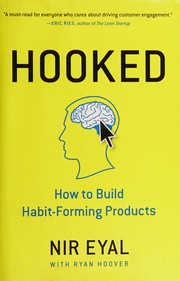
Hooked
The habit loop that makes a free product worth monetising.
Summary
Eyal presents a four-stage model for building products that create habitual use: trigger, action, variable reward and investment. External triggers such as notifications bring a user in initially, and the objective is to attach the behaviour to an internal trigger, usually a negative emotion such as boredom, loneliness or uncertainty, so the product becomes the automatic response to that state.
The action stage draws on BJ Fogg's behaviour model, requiring motivation, ability and a trigger to coincide, with the practical instruction that reducing the effort required works better than increasing motivation. The variable reward stage draws on the finding that unpredictable rewards produce stronger and more persistent behaviour than fixed ones, and Eyal divides rewards into those of the tribe, of the hunt and of the self. The investment stage argues that users who put work into a product, through content, data, followers or configuration, value it more and load the next trigger themselves.
Eyal includes a manipulation matrix that asks whether the maker uses the product and whether it materially improves users' lives, and argues that products failing both tests should not be built. He has since written Indistractable, which addresses the user side of the same mechanics.
The ethical problem is not resolved by the matrix. The book gives a working method for building compulsive products, and the subsequent decade of evidence about social media effects has made it read differently than it did in 2014. The research is reported secondhand and the case studies are selected. The model itself is accurate as a description of how habit-forming products work, which is precisely why the ethical framing matters more than Eyal allows.
Key takeaways 8
- Habit-forming products move users from external triggers such as notifications to internal triggers, usually a negative emotional state the product relieves.
- A behaviour requires motivation, ability and a trigger at the same moment, and reducing the effort required is more effective than increasing motivation.
- Variable rewards produce stronger and more persistent engagement than predictable rewards, because uncertainty sustains attention.
- Rewards divide into social validation, the pursuit of resources or information, and mastery, and different products use different types.
- Users who invest work into a product, through data, content or configuration, value it more and are less likely to leave.
- Investment should also load the next trigger, so each use of the product creates the reason for the following one.
- Habits form only where the behaviour is frequent enough and the perceived utility high enough, so infrequently used products cannot become habits.
- A product that the maker would not use themselves and that does not materially improve users' lives should not be built, which is Eyal's own test.
Who should read it
Product builders who want the mechanics of engagement stated explicitly, and anyone assessing whether a consumer product's retention is durable or extractive.
Who recommended it 9 · 1 direct
Similar books 6
Chosen by shared topics, the entries that hold them, and the people who recommended both.
The Google Ventures five-day workshop format distilled into a repeatable method for answering critical design questions through rapid prototyping and targeted user testing. Less a design book than a process book — most valuable for teams that struggle to move from ideas to validated decisions quickly.
Recommended by: Andy Budd, Jessica Hische, Marty Cagan and 1 other
Build, measure, learn: test what customers want with small experiments.
Recommended by: Nat Eliason, Sheryl Sandberg, Andrew Chen and 17 others
Why startups should build something new and own a small market before growing.
Recommended by: Balaji S. Srinivasan, Eric Weinstein and 36 others
The book that introduced affordances, signifiers, and feedback loops to a generation of designers. Norman's analysis of why doors, phones, and stoves confuse people is the clearest argument that bad design is a systems failure, not user error. Everything else on this list builds on this vocabulary.
Recommended by: Ran Segall, Andrew Chen, Garry Tan and 9 others
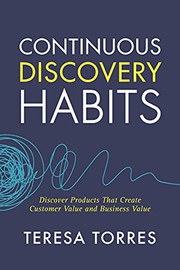
Torres operationalizes what Cagan describes. Weekly customer touchpoints, opportunity-solution trees, assumption testing — this is the most practical account of how discovery actually becomes a habit rather than a quarterly exercise. Pairs directly with Inspired as the how to its what.
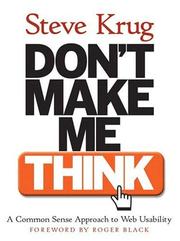
Krug's web usability primer has stayed relevant for over two decades because its core argument — that good interfaces require no instruction — is timeless. The chapters on navigation conventions and usability testing with five users are still the most practical introduction to the discipline.
Recommended by: Brian Armstrong, Andy Budd, Austen Allred and 6 others
Where it sits in the reference 5
Topics