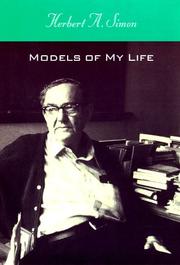
Models of My Life
A life across economics, psychology, organisations and artificial intelligence.
Memoir by the Nobel laureate who founded bounded rationality
Summary
Simon won the Nobel Prize in economics, helped found artificial intelligence, and worked across political science, psychology, organisation theory and computer science. This autobiography covers that range, from his childhood in Milwaukee and his municipal administration research in the 1930s through Carnegie Mellon, the Logic Theorist program, and the development of bounded rationality.
The intellectual through-line is a single question: how do people make decisions when they cannot possibly compute the optimum? Simon's answer, developed first in Administrative Behavior and elaborated for fifty years, is that people satisfice rather than maximise. They set an aspiration level, search until they find an option that meets it, and stop. He argues this is not a failure of rationality but the only rationality available to a system with limited computation facing an environment of enormous complexity. He applies the same framework to organisations, treating a firm as a structure that decomposes an unmanageable decision problem into parts small enough for people to handle.
Simon also uses the book to describe his own career as a series of decisions made under exactly the conditions he studied, including his account of academic politics, his fights over the direction of economics, and his view of why the field rejected his position. He is candid about which of his predictions about artificial intelligence were wrong, though he remained more optimistic than the record supported. The book is discursive and some sections on university administration are of limited interest. Read it for bounded rationality stated by its author and for the account of how a research programme crosses disciplines.
Key takeaways 7
- People satisfice rather than maximise, meaning they search until an option meets an aspiration level and then stop, because computing an optimum is impossible in real environments.
- Rationality is bounded by the computational limits of the decision-maker, so the correct model of choice is a search process rather than an optimisation.
- Organisations exist to decompose decision problems into pieces small enough for individuals with limited attention to handle.
- Attention, not information, is the scarce resource in an information-rich environment, and organisational design is largely the allocation of attention.
- Human problem solving proceeds by heuristic search through a space of possibilities, and this is what makes it simulable on a computer.
- Complex systems that survive are almost always hierarchical and nearly decomposable, because that structure allows parts to evolve without destabilising the whole.
- Expertise consists largely of a large stored repertoire of recognised patterns rather than superior reasoning ability.
Who should read it
Decision-makers and organisation designers who want bounded rationality and the attention-allocation argument from the person who developed them.
Who recommended it 2 · 2 direct
Similar books 6
Chosen by shared topics, the entries that hold them, and the people who recommended both.
A memoir told through portraits of the people the author knew, from Vienna on.
Recommended by: Mohnish Pabrai, Stewart Brand
The biases that distort managers' decisions, with exercises that show them.
“Max Bazerman, Judgment in Managerial Decision Making, 4th ed. (New York: John Wiley & Son, 1998), 6-17” — Michael Mauboussin
Source: The Janitor’s Dream: Why Listening to Individuals Can be Hazardous to Your Wealth, page 3
Recommended by: Michael Mauboussin, Mohnish Pabrai and 1 other
Complex problems yield to trial and error, not expert plans, and how to run it.
“There is a book I recently ran into by Tim Hartford called Adapt. That’s another kind of fun read; I thought that was pretty good.” — Mohnish Pabrai
Source: Pabrai Investment Funds Annual Meeting Transcript 2011, page 48
Recommended by: Mohnish Pabrai, Patrick O'Shaughnessy
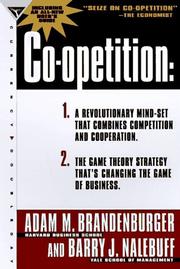
Game theory applied to business, which is cooperative and competitive at once.
“Adam M. Brandenburger and Barry J. Nalebuff, Co-opetition (New York: Currency Doubleday, 1996)” — Michael Mauboussin
Source: The Ecosystem Edge, page 10
Recommended by: Michael Mauboussin, Mohnish Pabrai
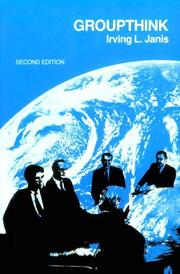
How the wish for agreement in close groups led to fiascos like the Bay of Pigs.
“Irving Janis, Groupthink: Psychological Studies of Policy Decisions and Fiascoes, 2nd ed. (Boston, MA: Houghton Mifflin, 1982)” — Michael Mauboussin
Source: Building an Effective Team: How to Manage a Team to Make Good Decisions, page 17
Recommended by: Adam Weiss, Barton Biggs, Michael Mauboussin
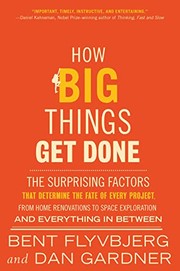
What 16,000 projects show about why big ones overrun, and how to plan them.
“Bent Flyvbjerg and Dan Gardner, How Big Things Get Done: The Surprising Factors That Determine the Fate of Every Project, from Home Renovations to Space Exploration and Everything In Between (New York: Crown Currency, 2023)” — Michael Mauboussin
Source: Pattern Recognition: Opportunities and Limits, page 14
Recommended by: Michael Mauboussin