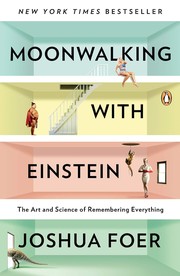
Moonwalking with Einstein
Summary
Foer, a journalist, covered the United States Memory Championship, became interested in the techniques competitors use, trained for a year under British competitor Ed Cooke and won the following year's championship. The book alternates between his training and reporting on memory science, memory history and unusual cases.
The technique is the method of loci, also called the memory palace, which converts information into vivid images placed at specific locations along a familiar route. Foer explains why it works: human memory is poorly adapted to abstract information and well adapted to spatial and visual material, so translating one into the other exploits a capacity that already exists. He covers the PAO system for numbers and card sequences, and the practice regime required.
The reporting sections cover the amnesiac EP, who could form no new memories; Kim Peek, the savant who inspired Rain Man; Daniel Tammet, whose claims Foer investigates sceptically; the history of memory as a discipline before printing made external storage cheap; and the finding that memory champions have ordinary brains and ordinary memory outside their trained domain.
The useful general argument concerns deliberate practice and what Ericsson calls the OK plateau, meaning the point where performance becomes automatic and stops improving. Foer describes deliberately staying in a mode of conscious control, working at speeds where he made errors, in order to keep improving. The book is journalism rather than instruction, and a reader wanting to learn the techniques will need a manual. The memory competition skills transfer poorly to general knowledge work, which Foer states honestly. The OK plateau material and the account of how expertise is built are the parts with wider application.
Key takeaways 8
- Human memory handles spatial and visual information far better than abstract information, so converting one into the other exploits an existing capacity.
- The memory palace technique places vivid images at locations along a familiar route, which allows sequential retrieval of arbitrary material.
- Memory champions have ordinary brains and ordinary memory outside the domain they have trained, which means the skill is technique rather than capacity.
- Performance becomes automatic and stops improving at a plateau, and progress requires deliberately returning to conscious control and working at error-producing speeds.
- Externalising memory into writing and printing removed the need for trained memory, and the techniques that were once general education disappeared.
- Elaborate and unusual images are remembered and ordinary ones are not, which is why the technique requires deliberately strange associations.
- Expertise depends on having a large store of memorised patterns, so memory and understanding are not the separate faculties that education treats them as.
- Competition memory skills transfer poorly to general knowledge work, which Foer states directly about his own experience.
Who should read it
Readers curious about how memory techniques work and about the mechanics of deliberate practice, treating it as reporting rather than as a manual.
Who recommended it 7 · 3 direct
Similar books 6
Chosen by shared topics, the entries that hold them, and the people who recommended both.
How timing, culture and accumulated advantage explain exceptional success.
Recommended by: Mohnish Pabrai, Tony Hsieh, Bill Gates and 6 others

How talent is grown, not born, through a brain mechanism training can tap.
Recommended by: Mohnish Pabrai, Nat Eliason, David Cancel and 2 others

Recommended by: Mohnish Pabrai

How experts in music, chess, medicine and sport excel through deliberate practice.
Recommended by: Nat Eliason

Early specialisation works only where rules are stable; elsewhere breadth wins.
Recommended by: Bill Gates, Abi Tyas Tunggal, Alex Lieberman and 11 others
Where it sits in the reference 0
No entry holds this book yet. It reached the reference because someone recommended it.
Topics