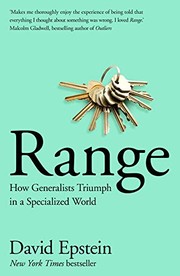
Range
The case for breadth over early specialisation in unpredictable domains
Summary
Epstein argues against early specialisation as a general prescription, holding that it works only in what psychologists call kind learning environments, where rules are stable, feedback is immediate and accurate, and patterns repeat. Chess, golf and firefighting are kind. Most professional and business situations are wicked environments, where rules are unclear, feedback is delayed or misleading, and the next case differs from the last.
The evidence draws on research including Tetlock's work on expert forecasting, Gary Klein and Kahneman's joint paper on when intuition can be trusted, studies of sampling periods in elite athletes, and research on analogical thinking by Dedre Gentner. Epstein opens by contrasting Tiger Woods, who specialised at two, with Roger Federer, who played many sports and specialised late, and he presents evidence that the second pattern is more common among elite athletes than the first.
His positive claims are that breadth improves analogical reasoning, that people who sample widely find better matches between their abilities and their work, that late specialisers who switch fields often outperform those who persisted, and that interdisciplinary teams solve problems that specialists cannot. He cites InnoCentive data showing that outside-field solvers frequently solved problems the sponsoring specialists could not.
The book is vulnerable on selection. Epstein assembles supportive cases and the counterexamples of successful early specialisers are numerous. The kind and wicked distinction is genuinely useful but he applies it loosely. The argument is directed against a strawman version of the ten thousand hours claim, which Ericsson stated more narrowly than the popular version. Read it as a corrective to the specialisation default rather than as a demonstrated rule.
Key takeaways 8
- Early specialisation produces superior results only in kind learning environments with stable rules and immediate accurate feedback.
- Most professional work occurs in wicked environments where accumulated pattern recognition misleads rather than helps.
- A sampling period in which a person tries several fields improves the eventual match between their abilities and their work.
- People who switch fields later carry analogies from previous domains that specialists in the new field cannot generate.
- Interleaved and spaced practice produces worse performance during training and better retention afterwards than blocked practice does.
- Outsiders solve specialist problems at meaningful rates, which means the boundary of a field is a constraint on it rather than a source of depth.
- Matching quality, meaning fit between a person and their work, contributes more to long-run performance than a head start does.
- Abandoning a path after investment is usually treated as failure when it is often the correct response to new information about fit.
Who should read it
Operators and investors making hiring and career decisions who want the argument against defaulting to narrow specialists.
Who recommended it 14 · 1 direct
Similar books 6
Chosen by shared topics, the entries that hold them, and the people who recommended both.
How shared fictions such as money, nations and gods let humans cooperate at scale.
“…books I've recommended, highlighted to death, or forced on friends.” — Andrew Wilkinson
Source: Andrew Wilkinson's Bookshelf, neverenough.com
Recommended by: Andrew Wilkinson, Bill Gates, Mohnish Pabrai and 38 others
Speeches making the case for a latticework of mental models from many fields.
“…books I've recommended, highlighted to death, or forced on friends.” — Andrew Wilkinson
Source: Andrew Wilkinson's Bookshelf, neverenough.com
Recommended by: Andrew Wilkinson, Charlie Munger and 26 others

Career capital before passion; building rare and valuable skills
Recommended by: Nat Eliason, Alexis Ohanian, Jordan Hughes and 2 others
Recommended by: Ana Fabrega, Chamath Palihapitiya, Jenny Chu and 2 others
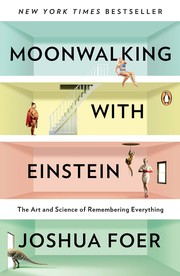
A journalist learns memory techniques and wins the US Memory Championship.
Recommended by: Bill Gates, Mohnish Pabrai, Nat Eliason and 4 others
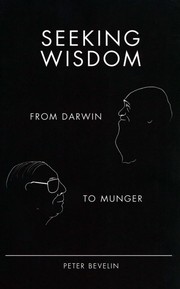
Builds out Munger's latticework idea from primary sources.
“…books I've recommended, highlighted to death, or forced on friends.” — Andrew Wilkinson
Source: Andrew Wilkinson's Bookshelf, neverenough.com
Recommended by: Andrew Wilkinson, Nat Eliason and 8 others
Where it sits in the reference 2
Topics