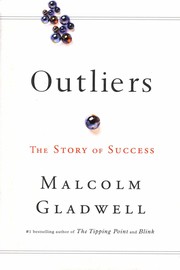
Outliers
Summary
Gladwell argues that exceptional success is explained by circumstances, timing, cultural inheritance and accumulated advantage rather than by individual talent and effort. The book is a set of case studies organised into opportunity and legacy.
The opportunity section covers relative age effects in Canadian hockey, where players born in the first months of the year dominate rosters because of the eligibility cutoff and the accumulating advantage of early selection; the ten thousand hour claim about practice, drawn from Anders Ericsson's research and illustrated with the Beatles in Hamburg and Bill Gates' unusual access to a computer terminal as a teenager; the birth-year clustering of technology founders and of nineteenth-century American industrialists; and the finding that very high intelligence beyond a threshold does not predict achievement, illustrated with Chris Langan against Robert Oppenheimer to argue that practical intelligence learned from family background determines who can act on opportunity.
The legacy section argues that cultural inheritance persists across generations, covering honour culture in the American South, the correlation between national power distance and airline accident rates using Korean Air as the case, and the argument that rice agriculture produced work habits that explain mathematics performance in East Asian countries.
The ten thousand hours claim is the most consequential and the most wrong. Ericsson himself objected that the number was an average rather than a threshold, that deliberate practice differs from accumulated hours, and that the amount required varies enormously by domain. The cultural chapters rest on correlational arguments that specialists reject. The relative age effect is well supported. Read the book as a set of provocations rather than as findings.
Key takeaways 8
- Success attributed to individual talent usually depends on circumstances of timing, access and accumulated early advantage.
- Arbitrary cutoff dates produce relative age effects, where children who are marginally older receive better coaching and opportunities that compound into real skill differences.
- Extraordinary performers accumulated unusual amounts of practice through circumstances that gave them access others did not have.
- Intelligence beyond a threshold does not predict achievement, and practical social competence learned from family background determines who converts ability into results.
- Birth year clusters among successful founders and industrialists indicate that being the right age at a technological transition matters more than individual quality.
- Cultural inheritance including attitudes to authority persists across generations and affects performance in domains far removed from its origin.
- Hierarchical communication patterns in cockpits contributed to accident rates, and changing the communication protocol changed the outcomes.
- The ten thousand hours figure is a misreading of the underlying research, which described an average rather than a threshold and emphasised the type of practice rather than the quantity.
Who should read it
Readers who want a provocation against pure meritocratic explanations of success, with the specific claims checked against the research they draw on.
Who recommended it 9 · 2 direct
Similar books 6
Chosen by shared topics, the entries that hold them, and the people who recommended both.

Recommended by: Graham Duncan, Ray Dalio

A journalist learns memory techniques and wins the US Memory Championship.
Recommended by: Bill Gates, Mohnish Pabrai, Nat Eliason and 4 others
How ideas and behaviour spread like epidemics, and the three factors that tip them.
Recommended by: Mohnish Pabrai, Tony Hsieh, Ev Williams and 2 others
Seven patterns, such as the adjacent possible, in the settings that produce ideas.
Recommended by: Andrew Wilkinson, Bill Gates, Mohnish Pabrai and 3 others
Gladwell on underdogs and mistaken assumptions about advantage
“…books I've recommended, highlighted to death, or forced on friends.” — Andrew Wilkinson
Source: Andrew Wilkinson's Bookshelf, neverenough.com
Recommended by: Andrew Wilkinson, Mohnish Pabrai and 1 other
Where it sits in the reference 0
No entry holds this book yet. It reached the reference because someone recommended it.
Topics