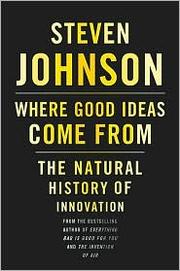
Where Good Ideas Come From
Summary
Johnson argues that innovation is an environmental and network property rather than an individual one, and identifies seven patterns that produce it: the adjacent possible, meaning that innovation moves into the space of what current components make reachable rather than jumping arbitrarily; liquid networks, meaning environments where ideas connect and recombine; the slow hunch, meaning that most breakthroughs develop over years as incomplete intuitions before they resolve; serendipity, meaning accidental connection between unrelated ideas; error, which he argues produces innovation by forcing exploration outside the productive path; exaptation, meaning the repurposing of something developed for another use; and platforms, meaning that innovations create the conditions for further innovations built on top.
His evidence includes historical cases such as Darwin's notebooks showing the theory developing years before he reported the insight, the coffee house as a physical liquid network, the double-entry ledger, Gutenberg's use of the wine press, the invention of the printing press from existing components, and the development of GPS.
He also presents an analysis of major innovations across four hundred years classified by whether they came from individuals or networks and from market or non-market settings, and reports that networked non-market innovation dominates, particularly in the recent period, which he uses to argue against strong intellectual property protection.
The historical cases are chosen after the outcome and the seven patterns are broad enough to describe almost any innovation retrospectively. The classification exercise depends heavily on how each innovation is coded. The adjacent possible and exaptation are the two concepts with the most analytical use.
Key takeaways 8
- Innovation moves into the adjacent possible, meaning the space that currently available components make reachable, rather than jumping to arbitrary new positions.
- Environments where ideas from different sources connect and recombine produce more innovation than environments organised around individual work.
- Most breakthroughs develop over years as incomplete intuitions rather than arriving as sudden insights, which the retrospective accounts conceal.
- Errors force exploration outside the productive path, which is why environments that eliminate error also eliminate discovery.
- Exaptation, meaning the repurposing of something developed for another purpose, accounts for a large share of significant innovations.
- Platforms create the conditions for innovations built on top of them, which compounds the return on making something open.
- Johnson's classification of four hundred years of innovation reports that networked non-market settings dominate, particularly recently.
- The seven patterns are broad enough to describe almost any innovation retrospectively, which limits their predictive use.
Who should read it
Operators designing environments for innovation who want the network and adjacent possible framing rather than accounts of individual genius.
Who recommended it 6 · 4 direct
Similar books 6
Chosen by shared topics, the entries that hold them, and the people who recommended both.
How timing, culture and accumulated advantage explain exceptional success.
Recommended by: Mohnish Pabrai, Tony Hsieh, Bill Gates and 6 others
What brain science says about learning, sleep, stress, memory and multitasking.
Recommended by: Mohnish Pabrai, Nat Eliason, Bill Gates and 1 other

Recommended by: Mohnish Pabrai

Prosperity grows as trade and specialisation let ideas meet and combine.
“…books I've recommended, highlighted to death, or forced on friends.” — Andrew Wilkinson
Source: Andrew Wilkinson's Bookshelf, neverenough.com
Recommended by: Andrew Wilkinson, Bill Gates, Frank Martin and 10 others
Explains an action by tracing its causes back from neurons to hormones to evolution.
“…books I've recommended, highlighted to death, or forced on friends.” — Andrew Wilkinson
Source: Andrew Wilkinson's Bookshelf, neverenough.com
Recommended by: Andrew Wilkinson, Bill Gates, Bryan Johnson and 5 others
A neurologist on the varieties of luck in scientific discovery
“wrote an outstanding book called Chase, Chance, and Creativity … It's the best book I've read on the role of luck, chance, and serendipity” — Marc Andreessen
Source: Luck and the Entrepreneur: The four kinds of luck, blog.pmarca.com
Recommended by: Marc Andreessen
Where it sits in the reference 0
No entry holds this book yet. It reached the reference because someone recommended it.
Topics