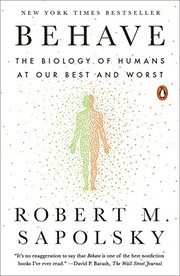
Behave
Biology of human behaviour across timescales, from neurons to culture
Summary
Sapolsky, a Stanford neurobiologist and primatologist, explains human behaviour by working backwards through time from any given action. He starts one second before the behaviour with the nervous system, then seconds to minutes earlier with sensory stimuli, hours to days with hormones, days to months with neural plasticity, years with adolescence and childhood, then foetal development, genes, culture, ecology and evolution. Each chapter covers one timescale.
The method is the argument. By the end Sapolsky has shown that no single level of explanation is sufficient, and that claims about the cause of a behaviour, whether genetic, hormonal, cultural or situational, are always partial. He is particularly good on how the same biology produces opposite behaviours depending on context, showing that testosterone amplifies whatever behaviour maintains status in a given culture rather than causing aggression, and that oxytocin increases in-group warmth and out-group hostility simultaneously.
The material on us and them distinctions, on hierarchy, on the amygdala and prefrontal cortex, and on how adolescent brain development explains risk-taking is directly relevant to anyone managing people. His treatment of implicit bias, of moral reasoning as post-hoc justification, and of how quickly and unconsciously group categorisation occurs is well documented.
The final chapters on free will and criminal justice are the most contested. Sapolsky argues that free will does not exist and that the criminal justice system should be rebuilt accordingly, which many readers find unpersuasive and which is philosophy rather than neuroscience. The book is long and technically dense, with substantial appendices on basic neuroscience and endocrinology. Some cited social psychology has replicated poorly. The multi-level framework is the durable contribution.
Key takeaways 8
- Any behaviour has causes operating at every timescale from milliseconds to evolutionary time, and explanations at a single level are always incomplete.
- Testosterone does not cause aggression, it amplifies whatever behaviour maintains status in a given culture, including generosity where that is what status requires.
- Oxytocin increases warmth toward the in-group and hostility toward outsiders at the same time, so it is not a prosocial hormone in any general sense.
- The brain categorises people into in-group and out-group within milliseconds and below conscious awareness, and the categories used are highly malleable.
- The prefrontal cortex is not fully developed until the mid-twenties, which explains adolescent risk-taking as a developmental fact rather than a character flaw.
- Moral judgments are usually made intuitively and then justified with reasoning constructed afterwards.
- Chronic stress damages the same brain regions responsible for regulating the stress response, which produces a self-reinforcing decline.
- Sapolsky argues that free will does not exist and that punishment should be reconceived accordingly, which is a philosophical position rather than an empirical finding.
Who should read it
Managers and investors who want a rigorous account of why human behaviour resists single-cause explanation, prepared for a long technical book.
Who recommended it 8 · 1 direct
“…books I've recommended, highlighted to death, or forced on friends.”
Similar books 6
Chosen by shared topics, the entries that hold them, and the people who recommended both.
Speeches making the case for a latticework of mental models from many fields.
“…books I've recommended, highlighted to death, or forced on friends.” — Andrew Wilkinson
Source: Andrew Wilkinson's Bookshelf, neverenough.com
Recommended by: Andrew Wilkinson, Charlie Munger and 26 others
Builds out Munger's latticework idea from primary sources.
“…books I've recommended, highlighted to death, or forced on friends.” — Andrew Wilkinson
Source: Andrew Wilkinson's Bookshelf, neverenough.com
Recommended by: Andrew Wilkinson, Nat Eliason and 8 others
Evolutionary psychology explained through Darwin's own life and behaviour.
Recommended by: Mohnish Pabrai, Ryan Holiday, Morgan Housel and 2 others
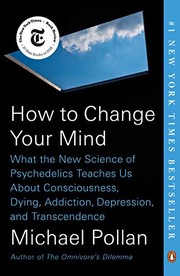
The history and revival of psychedelic research, and the author's own trips.
Recommended by: Bill Gates, Bryan Johnson, James Cameron and 7 others
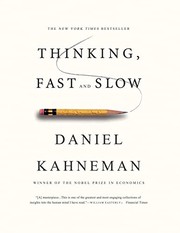
Kahneman's synthesis of behavioral economics is the cognitive science underpinning every negotiation tactic. Anchoring, loss aversion, framing effects, and the planning fallacy — understanding why these biases operate, not just that they exist, makes you harder to exploit and more honest about your own irrationality.
“…books I've recommended, highlighted to death, or forced on friends.” — Andrew Wilkinson
Source: Andrew Wilkinson's Bookshelf, neverenough.com
Recommended by: Andrew Wilkinson, Charles de Vaulx and 32 others

Why parents have less effect on how children turn out than people assume.
“the one thing that I found to be really interesting, and to some degree liberating, is the work of Judith Rich Harris” — Michael Mauboussin
Source: The Tim Ferriss Show #659 — official transcript
Recommended by: Michael Mauboussin
Where it sits in the reference 2
Topics