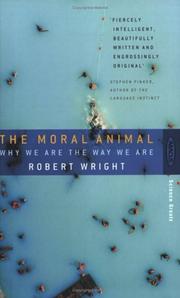
The Moral Animal
Evolutionary psychology as an account of motive and reciprocity
Summary
Wright presents evolutionary psychology for a general reader, using Darwin's own life as a running case study to show how the theory explains behaviour that Darwin himself displayed without understanding.
The substantive content covers parental investment theory and its predictions about mating behaviour, the different reproductive strategies available to each sex and the resulting conflicts, kin selection and Hamilton's rule explaining altruism toward relatives, reciprocal altruism and the conditions under which cooperation between unrelated individuals is stable, status competition, and the argument that moral sentiments including guilt, gratitude, indignation and affection are mechanisms evolved to make reciprocal exchange work.
His most consequential argument concerns self-deception. Wright holds that the conscious mind functions substantially as a public relations department, constructing justifications for behaviour whose actual causes are inaccessible, and that this is adaptive because a person who genuinely believes their own case argues it more convincingly. This anticipates the argument Simler and Hanson made later in The Elephant in the Brain. The Darwin biography running through the book shows Darwin's own status anxiety, his treatment of Wallace, his family relationships and his Victorian moral positions, all analysed through the framework.
Evolutionary psychology has been substantially contested since 1994, on the grounds that its hypotheses are difficult to falsify, that the cross-cultural evidence is weaker than claimed, and that it has been used to naturalise existing arrangements. Wright is careful to state that explanation is not justification, which readers frequently ignore. The self-deception argument is the part with the most durable support.
Key takeaways 8
- Moral sentiments including guilt, gratitude and indignation are mechanisms that make reciprocal exchange work between individuals who could otherwise defect.
- The conscious mind constructs justifications for behaviour whose actual causes are inaccessible, which is adaptive because sincere advocates are more persuasive.
- The sex that invests more in offspring is more selective about mates, which predicts observable differences in mating behaviour.
- Altruism toward relatives follows from shared genes weighted by relatedness and by the ratio of cost to benefit.
- Cooperation between unrelated individuals is stable only where interactions repeat and defection can be detected and punished.
- Status competition is a reproductive strategy rather than a cultural artefact, which is why it persists across societies with different values.
- Explaining a behaviour evolutionarily does not justify it, which Wright states explicitly and which readers routinely ignore.
- Evolutionary psychology's hypotheses are difficult to falsify, which is the central methodological objection to the field.
Who should read it
Readers who want the evolutionary account of moral sentiment and self-deception, with the field's methodological problems in view.
Who recommended it 5 · 2 direct
Similar books 6
Chosen by shared topics, the entries that hold them, and the people who recommended both.

Sex evolved as a defence against parasites, and that shapes human mating.
“I really highly, highly recommend picking up Genome, The Red Queen, Origins of Virtue, The Rational Optimist, and The Evolution of Everything.” — Naval Ravikant
Source: The Tim Ferriss Show — Naval Ravikant Q&A, full transcript
Recommended by: Mohnish Pabrai, Naval Ravikant, Seth Klarman and 1 other

Behavioural genetics on how much of an outcome is inherited
Recommended by: James Cameron, Michael Mauboussin
Explains an action by tracing its causes back from neurons to hormones to evolution.
“…books I've recommended, highlighted to death, or forced on friends.” — Andrew Wilkinson
Source: Andrew Wilkinson's Bookshelf, neverenough.com
Recommended by: Andrew Wilkinson, Bill Gates, Bryan Johnson and 5 others
How cooperation and morality evolved from self-interest, via the prisoner's dilemma.
“I really highly, highly recommend picking up Genome, The Red Queen, Origins of Virtue, The Rational Optimist, and The Evolution of Everything.” — Naval Ravikant
Source: The Tim Ferriss Show — Naval Ravikant Q&A, full transcript
Recommended by: Mohnish Pabrai, Naval Ravikant, Ryan Holiday

Twenty-three chapters, one per chromosome, each using a gene to open a subject.
“I highly recommend Genome as well, to figure out the rational basis behind ethics and the origin of virtue.” — Naval Ravikant
Source: Nav.al — 'Matt Ridley: How Innovation Works, Part 2' (Naval's podcast, edited transcript)
Recommended by: Charlie Munger, Mohnish Pabrai and 2 others
Species change over time as natural selection favours heritable variations.
“may have done more than any, with the exception of the Bible, to shape man's self-perception” — Nick Sleep
Source: Nomad Investment Partnership, Interim Letter for the period ended June 30th, 2009, p. 158
Recommended by: Jim Collins, Mohnish Pabrai, Naval Ravikant and 5 others
Where it sits in the reference 2
Topics