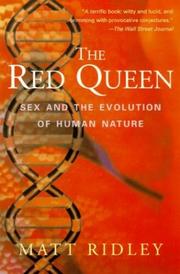
The Red Queen
Summary
Ridley presents the case that sexual reproduction exists as a defence against parasites, and uses that argument to explain human sexual behaviour, mate selection and the differences between the sexes. The title comes from Van Valen's hypothesis that species must keep evolving simply to maintain their relative position, which he named after the character in Carroll who runs to stay in the same place.
The core biological puzzle is that sexual reproduction halves the genetic contribution of each parent and costs enormously compared to asexual reproduction, so it requires a substantial compensating benefit. Ridley's answer, drawing on Hamilton and others, is that parasites evolve far faster than their hosts because of shorter generations, and that recombination allows hosts to produce genetically varied offspring that parasites cannot all be adapted to.
He then applies evolutionary reasoning to human behaviour, covering parental investment theory and why the sex investing more is more selective, sexual selection and the peacock problem, monogamy and its instability, the evidence around human mate preferences across cultures, and the argument that human intelligence may itself have been sexually selected.
The book is from 1993 and evolutionary psychology has been substantially contested since, both on methodology and on the interpretation of cross-cultural preference data. Ridley states positions more confidently than the evidence supports, particularly on sex differences. The parasite explanation of sex remains one of several competing hypotheses rather than a settled result. The Red Queen concept itself, that competitive advantage erodes as competitors adapt, transfers directly to business strategy.
Key takeaways 8
- Sexual reproduction is enormously costly and requires a compensating benefit large enough to justify halving each parent's genetic contribution.
- Parasites evolve much faster than their hosts because of shorter generations, which is Ridley's proposed explanation for why genetic recombination pays.
- Species must continue evolving simply to maintain their relative position against competitors and parasites that are also evolving.
- The sex that invests more in offspring is more selective about mates, which predicts observable differences in mating behaviour across species.
- Traits that are costly to their bearers can be selected because they signal quality that cannot be faked, which is the basis of sexual selection.
- Human intelligence may itself have been sexually selected rather than selected for survival advantage, which Ridley presents as a serious hypothesis.
- Competitive advantage erodes as competitors adapt, which is the business application of the Red Queen concept.
- Evolutionary psychology's cross-cultural preference evidence has been substantially contested since publication, and Ridley states these claims more firmly than the evidence supports.
Who should read it
Readers who want the evolutionary account of sex and the Red Queen concept, with the human behaviour chapters treated as substantially contested.
About Matt Ridley
British science writer and member of the House of Lords, former chairman of Northern Rock, writing on evolution, genomics, trade and innovation.
The Rational Optimist argues that exchange and specialisation, not individual intelligence, drive rising living standards, and assembles the long-run price and productivity evidence behind the claim. How Innovation Works applies the same method to case histories, showing invention as incremental, collective and largely detached from formal research spending.
Who recommended it 4 · 3 direct
“I really highly, highly recommend picking up Genome, The Red Queen, Origins of Virtue, The Rational Optimist, and The Evolution of Everything.”
“I love the Red Queen, evolutionary biology.”
Similar books 6
Chosen by shared topics, the entries that hold them, and the people who recommended both.
Twenty-three chapters, one per chromosome, each using a gene to open a subject.
“I highly recommend Genome as well, to figure out the rational basis behind ethics and the origin of virtue.” — Naval Ravikant
Source: Nav.al — 'Matt Ridley: How Innovation Works, Part 2' (Naval's podcast, edited transcript)
Recommended by: Charlie Munger, Mohnish Pabrai and 2 others
How cooperation and morality evolved from self-interest, via the prisoner's dilemma.
“I really highly, highly recommend picking up Genome, The Red Queen, Origins of Virtue, The Rational Optimist, and The Evolution of Everything.” — Naval Ravikant
Source: The Tim Ferriss Show — Naval Ravikant Q&A, full transcript
Recommended by: Mohnish Pabrai, Naval Ravikant, Ryan Holiday
How genes and experience interact, each shaping how the other acts.
Recommended by: Naval Ravikant
How genes and experience interact, each shaping how the other acts.
Recommended by: Naval Ravikant
Evolutionary psychology explained through Darwin's own life and behaviour.
Recommended by: Mohnish Pabrai, Ryan Holiday, Morgan Housel and 2 others
Prosperity grows as trade and specialisation let ideas meet and combine.
“…books I've recommended, highlighted to death, or forced on friends.” — Andrew Wilkinson
Source: Andrew Wilkinson's Bookshelf, neverenough.com
Recommended by: Andrew Wilkinson, Bill Gates, Frank Martin and 10 others
Where it sits in the reference 3
Topics