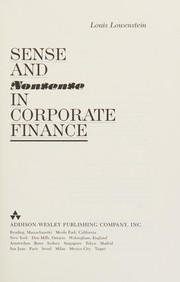
Sense and Nonsense in Corporate Finance
Sceptical look at corporate finance orthodoxy and reported earnings
Summary
Louis Lowenstein, a former corporate chief executive who became a Columbia law professor, attacks the assumptions underlying much of 1980s corporate finance practice and academic theory. His targets are the efficient market hypothesis as applied to corporate decisions, the takeover boom, the use of accounting earnings as a management objective, and the transaction-driven advice supplied by investment banks.
His argument is that markets price securities on short-horizon information and that managers who take the price as a verdict on their decisions will systematically underinvest. He examines the leveraged buyout wave and argues that a substantial part of the gains came from tax deductibility of interest, from wage and pension reductions, and from underpriced targets rather than from operating improvement. He is critical of the academic finance literature for using event studies over short windows, which he argues measures market reaction rather than value creation.
He also covers accounting, arguing that reported earnings can be managed sufficiently to make earnings-based compensation and valuation unreliable, and that cash flow analysis and balance sheet examination are what a serious investor or director should use.
The book is argued from a position and Lowenstein is combative about the finance profession. Its specific institutional detail is from the late 1980s and is dated, and several of his empirical claims about buyout returns were contested at the time and have been partially superseded by better data. The scepticism about short-window event studies and about earnings as an objective has held up well.
Key takeaways 7
- Securities markets price on short-horizon information, so a manager who treats the current share price as a verdict on long-horizon decisions will underinvest.
- A substantial share of leveraged buyout gains came from interest deductibility, wage and pension reductions, and underpriced targets rather than from operating improvement.
- Short-window event studies measure the market's immediate reaction rather than whether value was created, which makes them weak evidence about transactions.
- Reported earnings are manageable enough that earnings-based compensation and valuation are unreliable measures of performance.
- Investment banks are paid for transactions and therefore supply advice that leads to transactions, which directors should discount accordingly.
- Corporate directors should analyse cash generation and the balance sheet rather than accept earnings and market price as sufficient information.
- The theory that the market disciplines managers through the threat of takeover assumes the market values long-horizon investment correctly, which it does not.
Who should read it
Directors and investors who want a sceptical corporate finance perspective on takeovers, earnings-based objectives and transaction-driven advice.
Who recommended it 1 · 1 direct
“When you think you've got it all figured out, try Sense and Nonsense in Corporate Finance.”
Similar books 6
Chosen by shared topics, the entries that hold them, and the people who recommended both.
Berkshire's shareholder letters arranged by topic: governance, valuation, mergers.
“The resource is as valuable as Larry Cunningham's The Essays of Warren Buffett, which similarly organizes by subject matter” — Christopher Bloomstran
Source: Semper Augustus 2024 Letter to Clients, 'Books and Tunes for Walking', p. 96
Recommended by: Christopher Bloomstran, Francois Rochon and 11 others
Value is discounted future cash flow, not earnings per share or return on equity.
“I read that book and the light bulbs all went off for me personally.” — Michael Mauboussin
Source: The Tim Ferriss Show #659 — official transcript
Recommended by: Michael Mauboussin, Mohnish Pabrai
How the chase for short-term share prices corrupted shareholder value, and fixes.
Recommended by: Patrick O'Shaughnessy
Plain-language primer on financial statements and how securities work
“I highly recommend Janet Lowe's Value Investing Made Easy as a primer. I'd follow that book with Why Stocks Go Up (and Down) by William Pike.” — Michael Burry
Source: Silicon Investor 'Value Investing' thread, msg 1569363 (June 10, 1997) — archived
Recommended by: Michael Burry
Every Berkshire annual letter since 1965, in order, as the company grew.
“…books I've recommended, highlighted to death, or forced on friends.” — Andrew Wilkinson
Source: Andrew Wilkinson's Bookshelf, neverenough.com
Recommended by: Andrew Wilkinson, Arnold Van Den Berg and 5 others
A large-fund manager's framework for ranking buybacks against alternatives.
Where it sits in the reference 2
Topics