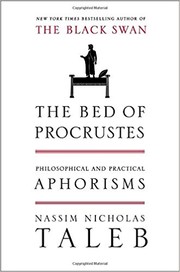
The Bed of Procrustes
Aphorisms stating Taleb's ideas on randomness, knowledge and modern life.
Incerto volume 3; aphorisms
Summary
Taleb's book of aphorisms is the shortest volume in his Incerto series and states his positions without the argument and evidence that fill the other books. The title refers to the Greek figure who stretched or amputated guests to fit his bed, which Taleb uses as his image for forcing reality to fit models rather than adjusting the models.
The aphorisms cover the recurring subjects of his work: the distinction between what is measurable and what matters, the difference between knowledge from practice and knowledge from theory, the mechanisms of self-deception, the corruption of institutions by people who bear no risk, and the properties of systems that gain from disorder.
Specific lines that circulate widely include the observation that the person who has fewer options thinks more clearly, that what is not intelligible to a person is not necessarily unintelligent, that the opposite of success is not failure but the pursuit of a narrow definition of success, and various formulations about the difference between the visible and the consequential. There are also aphorisms on modernity, on the difference between ancient and contemporary conceptions of a good life, and a substantial number of attacks on academics, economists and journalists.
The form provides no argument, so a reader cannot evaluate any claim. Readers unfamiliar with Taleb's other work will find much of it opaque, since the aphorisms compress arguments made elsewhere. Some are sharp and some are simply insults. It works as a supplement for readers who have read the other volumes and as a source of compressed statements of positions argued at length elsewhere.
Key takeaways 8
- Forcing reality into a model, rather than adjusting the model, is the recurring error the title names.
- What is measurable and what matters are frequently different, and institutions optimise for the first because the second cannot be reported.
- Knowledge acquired through practice differs in kind from knowledge acquired through theory, and the second is systematically overvalued.
- A person with fewer options reasons more clearly, because the absence of alternatives removes the incentive to rationalise.
- Institutions are corrupted by people who make decisions without bearing the consequences, which is the central argument of Taleb's later work.
- Success defined narrowly and pursued single-mindedly produces a worse outcome than failure at a broader definition.
- The aphoristic form states positions without argument, so readers cannot evaluate any of the claims from this book alone.
- The material compresses arguments made at length in Taleb's other volumes and will be opaque to readers who have not read them.
Who should read it
Readers already familiar with Taleb's arguments who want them compressed, not a starting point for anyone new to his work.
About Nassim Nicholas Taleb
Former options trader; Distinguished Professor of Risk Engineering, NYU Tandon; scientific adviser to Universa Investments
The Incerto is the primary source for how markets and institutions handle tail risk, and the accompanying technical work supplies the mathematics others cite.
Who recommended it 6 · 3 direct
“I'm thrilled if I get a few counter-intuitive thought-provoking ideas from any source. This book is filled with his usual cocktail party sprezzatura bravado, but refreshingly succinct, minus his usual blowhard explanations of his superior scholarly approach to life.”
“This is his collection of ancient wisdom.”
Similar books 6
Chosen by shared topics, the entries that hold them, and the people who recommended both.
Rare, unforeseen, high-impact events drive history, explained only after the fact.
“The Black Swan U The best-known bird around today is The Black Swan, the second book from Nassim Nicolas Taleb.” — Howard Marks
Source: The Complete Collection, page 530
Recommended by: David Perell, Howard Marks, Marc Andreessen and 20 others
Why some things gain from volatility and disorder, and how to build them.
“Antifragile. Loved the first 1/3 and last 1/3 of this book.” — Andrew Chen
Source: Books I’m reading (2013)
Recommended by: Ana Fabrega, Andrew Chen, Derek Sivers and 24 others
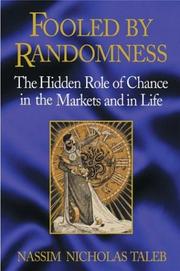
Why people mistake luck for skill, above all in markets.
“Fooled By Randomness was unquestionably the best non-fiction book I read in 2005.” — Brad Feld
Source: Book Review: Fooled By Randomness — Feld Thoughts
Recommended by: Barton Biggs, Brad Feld, Derek Sivers and 15 others
Why people who make decisions for others must share in the downside.
“Skin in the Game by @nntaleb is one of my all-time favorite books.” — Ana Fabrega
Source: Fab Fridays 88: How to Pick a Good Book - by Ana Lorena
Recommended by: Ana Fabrega, David Perell, Derek Sivers and 14 others
Life in Nazi concentration camps, and logotherapy: finding meaning to survive.
“What's more certain to me is that we all need a why, as Viktor Frankl told us in Man's Search for Meaning.” — David Heinemeier Hansson
Source: Universal Basic Dead End
Recommended by: David Heinemeier Hansson, David Perell and 29 others
Twelve rules for living, each drawn from clinical practice, biology and myth.
“A unique thinker with strong opinions presented as indisputable fact. More surprisingly interesting ideas than almost any book I've ever read. Extremely thoughtful, but occasionally abruptly concludes with an unsupported point. It has a conservative “this is how it is” certainty. It’s a broad collection of thoughtful insights on life, mixed with a lot of Bible interpretation.” — Derek Sivers
Source: Derek Sivers book notes (primary, rated list) · Rating: 9/10
Recommended by: Derek Sivers, Guy Spier, Nat Eliason and 8 others