Updates

  1. Person pages list letters, writing, profiles and links as sortable tables with filters, and show each person's companies as links; Fund letters show each letter's description in its own column.
  2. Experts show a checked job title and a short description of each person; 30 more people have photographs.
  3. Every company, fund, university and publication the experts work for has a page listing the people there.
  4. Fund letters show each letter's thesis and filter by it; 225 person pages list the essays, columns and newsletter issues the person wrote.
  5. Person pages list every essay and newsletter issue a person wrote, and their own books as a table in List view.
  6. Recommends shows the five largest kinds of book and the rest under More; browse pictures load sooner.
  7. Podcasts and talks link the original episode, filter by Audio and video or Press, and list each publisher once.
  8. Pages are wider, Recommends has List and Grid, and a filter clicked again turns off.
  9. Book cards sit in a ruled grid with Open Library and Goodreads links and each book's one-line note.
  10. Funds is now Investors; each investor's styles are buttons that filter the table.
  11. Podcasts and talks on a person's page filter by year and publisher and show as a list or a grid of pictures.
  12. Quotes show only people's own words: 472 summaries written by list sites are gone.
  13. Country pages open from Browse again, and every link on the shelf lands on a page.
  14. Subject and person pages show their sections as tabs, and each book appears once on a person's page.
  15. Book cards show the quote, who said it and the source; grids show five cards to a row.
  16. On a phone, a menu holds the sections, search, Updates, Feedback and dark mode.
  17. Feedback takes a screenshot of the page with no browser prompt, opens a screenshot full size when you click it, and clears itself once sent.
  18. Book cards are centred, search names the topic each book sits in, and any text cut short shows whole on hover.
  19. Search groups its results by kind: people, companies, geographies, subjects, topics, books, funds, fund letters and papers.
  20. The Books table lists who recommended each book by name, and the browser tab names the section you are in.
  21. Feedback can take a screenshot of the page, or one you paste or choose, and opens in the corner beside Updates.
  22. Each rail button reopens its section where you left it, and Browse, Table and People show on every book and subject page.
  23. Filters grey out choices that hold nothing instead of hiding them, and Books › People filters by authors or recommenders.
  24. Feedback takes a subject line and up to three screenshots.
  25. Biographies are grouped by the person they are about: 41 new pages, from Abraham Lincoln to Lee Kuan Yew.
  26. Sport splits into 23 sports, and Religion into one topic per faith.
  27. Book lists show as cards: the cover, one recommendation quote and every recommender by name.
  28. Seventeen subjects that had two or three pages under different names now have one page each.
  29. Every page lists its Experts as authors and recommenders, with a link to them on the Experts tab.
  30. Economics, Financial history, Financial panics and Accounting are subjects of their own, with one page per financial crisis.
  31. Book, person and subject pages open inside the app, so the tabs stay in view.
  32. 996 more book covers, and photographs or logos for 227 more people and companies.
  33. Books › Browse shows every subject as cards, and the rail holds Fund letters, Papers, Experts, Books and Funds.
  34. Every topic over 150 books splits into narrower topics, each with a page of its own.

Send feedback

What is it?
Screenshots, up to 3 (optional)
or paste one with Ctrl+V

We use your email only to reply to you.

The Death and Life of Great American Cities

The Death and Life of Great American Cities

Jane Jacobs
1961
T1 472 pages · about 7h 52m to read Open Librarygoodreads

Still the founding text on how urban value is actually created.

Summary

Jacobs attacked the urban planning orthodoxy of the 1950s, which favoured separated land uses, superblocks, tower housing in open space and the clearance of neighbourhoods deemed slums. She argued from direct observation that this approach destroyed the conditions that make cities work, and she wrote as a journalist and resident rather than as a planner.

Her central argument is that cities depend on dense, mixed, continuous street activity. She identifies four conditions for diversity: a district must serve more than one primary function so that people are present at different times of day; blocks must be short so that routes intersect and streets are used; buildings must vary in age and condition so that rents vary and different uses are affordable; and density of population must be sufficiently high.

The eyes on the street concept holds that public safety comes from continuous informal observation by people who have reason to be present, not from policing or from design that separates people from streets. She develops the idea of the sidewalk as the site of unplanned contact that builds the trust a neighbourhood runs on. Her attack on urban renewal is specific and she documents projects that destroyed functioning neighbourhoods and produced the conditions they were meant to remove.

Jacobs opposed Robert Moses directly and stopped the Lower Manhattan Expressway. Her framework has been criticised for underweighting the role of housing supply and for having been adopted by residents opposing development, which uses her arguments against the density she advocated. Her observational method has no statistical apparatus, which specialists note. The four conditions remain the standard framework for thinking about urban vitality.

Key takeaways 8

  1. City districts require mixed primary uses so that people are present at different times of day, since single-use areas empty and become unsafe.
  2. Short blocks create intersecting routes that put people on more streets, which is what generates the activity a district depends on.
  3. Buildings of varying age and condition produce varying rents, which is what allows new and marginal businesses to exist.
  4. Sufficient residential density is a requirement rather than a problem, and the planning profession treated it as the opposite.
  5. Public safety comes from continuous informal observation by people who have reason to be on the street rather than from policing or from design.
  6. Repeated casual contact on sidewalks builds the trust that allows a neighbourhood to function, and it cannot be produced by designed community facilities.
  7. Clearance of neighbourhoods labelled as slums destroyed functioning social and economic networks that no rebuilding replaced.
  8. Her arguments have been adopted by residents opposing development, which uses them against the density she was arguing for.

Who should read it

Anyone thinking about cities, physical spaces or the conditions that produce unplanned interaction, including people designing offices and campuses.

Who recommended it 4 · 1 direct

Chris Dixonreported
Daniel Burkareported
Sam Altmanreported

Similar books 6

Chosen by shared topics, the entries that hold them, and the people who recommended both.
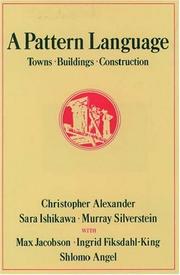
Christopher Alexander · 1977

253 patterns for building, from the layout of towns down to a window seat.

Stewart Brand · 1994

Buildings as processes that change after they are built, and how to design for it.

Doug Saunders · 2010

The migrant districts on the edges of growing cities, where rural people move to.
Alain Bertaud · 2018

Cities as labour markets, and planning that works with land markets.

Where it sits in the reference 1

Secular themes

Topics

Sociology and CultureArt and DesignArchitecture, Interiors and CitiesCities and urban life