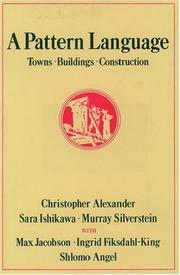
A Pattern Language
Design patterns for towns and buildings; the origin of pattern thinking
Summary
Alexander and colleagues at the Center for Environmental Structure present two hundred and fifty-three patterns for building at every scale, from the organisation of regions and towns down to the placement of a window seat. Each pattern has the same structure: a name, a photograph, a statement of the problem, the body of evidence and reasoning, the solution stated as an instruction, and links to the larger patterns it helps complete and the smaller ones needed to complete it.
The patterns are ordered by scale, beginning with independent regions, city country fingers and the distribution of towns, moving through neighbourhood patterns including identifiable neighbourhood and four-storey limit, to building patterns including light on two sides of every room, alcoves, entrance transition and common areas at the heart, and ending with construction details.
The underlying argument is that ordinary people, rather than professional architects, should shape the places they live, and that a shared language of patterns makes that possible. Alexander's claim is that traditional building produced good places because such languages existed and were widely held, and that professionalisation destroyed them.
The evidence for individual patterns varies enormously. Some cite research, some cite observation, and some are assertion. Architects have criticised the book for prescriptiveness and for its hostility to the profession. Its largest influence has been outside architecture entirely: the software design patterns movement took its structure directly from this book, and the wiki was invented by Ward Cunningham to hold a pattern language. Read it for the method of stating a recurring problem with a tested solution and for the specific building patterns, which are unusually concrete.
Key takeaways 8
- A pattern names a recurring problem, states the context in which it occurs, and gives a solution that can be applied repeatedly without being the same twice.
- Patterns connect at different scales, so each one is completed by smaller patterns and helps complete larger ones, which makes them a language rather than a list.
- Every room should have light on at least two sides, which Alexander identifies as the single pattern that most determines whether a room is used.
- Ordinary people rather than professionals should shape the places they live, and a shared pattern language is what makes that possible.
- Traditional building produced good places because such languages were widely held, and professional specialisation destroyed them.
- Buildings should grow through repair and incremental change rather than being completed once and then degraded.
- A pattern is a hypothesis about what works, stated so that it can be tested and revised rather than accepted on authority.
- The book's structure was adopted directly by the software design patterns movement and by the invention of the wiki.
Who should read it
Anyone designing physical spaces, and software and organisational designers wanting the source of the pattern method.
Who recommended it 4
Similar books 6
Chosen by shared topics, the entries that hold them, and the people who recommended both.
What makes city streets work, and how 1950s planning and slum clearance broke them.
Recommended by: Patrick Collison, Chris Dixon, Daniel Burka and 1 other

How a mind could arise from parts, traced through Godel, Escher and Bach.
Recommended by: Nat Eliason, Naval Ravikant, Demis Hassabis and 3 others

Buildings as processes that change after they are built, and how to design for it.
Recommended by: Stewart Brand, Caterina Fake, Daniel Burka and 3 others
Meadows wrote this before systems thinking became a popular phrase, and it remains the clearest account of why short-term interventions in complex systems so often backfire. The chapter on leverage points is the conceptual core of what long-term thinking actually requires from decision-makers.
Recommended by: Patrick O'Shaughnessy, Daniel Burka and 3 others
How dense cities make people more productive, inventive and green.
“on the central role cities play in our world and why it's so important for us to build them” — Marc Andreessen
Source: @pmarca, companion thread to 'It's Time to Build'
Recommended by: Marc Andreessen, Mohnish Pabrai and 2 others

Recommended by: Patrick Collison
Where it sits in the reference 2
Topics