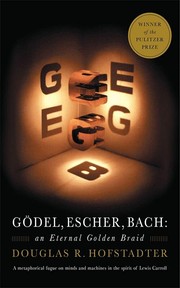
Godel, Escher, Bach
Self-reference and strange loops across mathematics, art and music
Summary
Hofstadter constructs an argument about how consciousness could arise from non-conscious components, using Godel's incompleteness theorems, Escher's self-referential images and Bach's canons and fugues as parallel examples of what he calls strange loops. A strange loop occurs when moving through a hierarchical system returns you to where you started, and Hofstadter argues that a sufficiently complex formal system capable of referring to itself produces this structure.
The technical core is Godel's proof. Hofstadter builds the reader up to it through formal systems, showing how a system of symbols with rules can be assigned meaning, how numbers can encode statements about numbers, and how this permits a statement that asserts its own unprovability. The consequence is that any consistent formal system strong enough to describe arithmetic contains true statements it cannot prove.
Hofstadter's larger claim is that the self is a strange loop of this kind: a pattern in the brain that models itself, producing an apparently causal entity that has no separate physical existence. He applies this to artificial intelligence, to molecular biology where DNA both encodes and is manipulated by proteins, and to the question of whether meaning is intrinsic. The book alternates chapters with dialogues between Achilles and the Tortoise that illustrate the concepts structurally, imitating Bach forms.
It is long, difficult and demands active work. Many people start it and few finish. Hofstadter has said repeatedly that readers misunderstand it as a book about mathematics, music and art when it is a book about how selves arise from matter. The artificial intelligence material predates modern machine learning entirely and its predictions about what would be hard have not held.
Key takeaways 8
- Any consistent formal system powerful enough to express arithmetic contains true statements that it cannot prove, which is Godel's incompleteness result.
- Self-reference in a sufficiently powerful system produces structures that cannot be resolved from inside that system.
- A strange loop occurs when moving upward or downward through a hierarchy returns you to the starting level, and Hofstadter argues the self is such a loop.
- Meaning can emerge from the manipulation of symbols that individually have no meaning, provided the system's structure maps onto something.
- Consciousness may be a pattern that models itself rather than a separate substance or a special component.
- Levels of description can be genuinely independent, so a system's behaviour at one level need not be described in the vocabulary of the level below it.
- DNA both encodes proteins and is manipulated by them, which is a physical instance of the self-referential loop the book describes.
- The book's predictions about which cognitive tasks would prove difficult for machines have not been borne out by subsequent developments.
Who should read it
Readers willing to work through a demanding book for an argument about how self-reference in complex systems could produce minds.
Who recommended it 6 · 2 direct
Similar books 6
Chosen by shared topics, the entries that hold them, and the people who recommended both.
Control and communication in animals and machines run on the same principles.
Meadows wrote this before systems thinking became a popular phrase, and it remains the clearest account of why short-term interventions in complex systems so often backfire. The chapter on leverage points is the conceptual core of what long-term thinking actually requires from decision-makers.
Recommended by: Patrick O'Shaughnessy, Daniel Burka and 3 others

Five disciplines, led by systems thinking, that let an organisation learn.
Recommended by: Mohnish Pabrai, Sahil Lavingia

Honeybee colonies as a decentralised allocation and search system
“As Thomas Seeley writes in his delightful book, The Wisdom of the Hive” — Michael Mauboussin
Source: Capital Ideas Revisited (Legg Mason Capital Management)
Recommended by: Michael Mauboussin

How the sciences and humanities can be unified by causal links from physics up.
“I was inspired by E. O. Wilson's book Consilience, which came out in 1998 and is a book I'd recommend.” — Michael Mauboussin
Source: MOI Global interview with Michael Mauboussin
Recommended by: Michael Mauboussin, Mohnish Pabrai

Information theory as a unifying idea across three scientists' work
Recommended by: Charlie Munger, Mohnish Pabrai
Where it sits in the reference 2
Topics