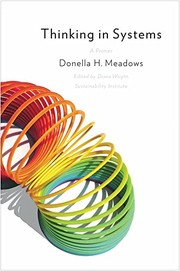
Thinking in Systems
Meadows wrote this before systems thinking became a popular phrase, and it remains the clearest account of why short-term interventions in complex systems so often backfire. The chapter on leverage points is the conceptual core of what long-term thinking actually requires from decision-makers.
Summary
Meadows, an environmental scientist who worked on the Limits to Growth modelling, wrote an introduction to systems dynamics that was completed by colleagues and published in 2008 after her death. The book teaches how to see stocks, flows, feedback loops and delays, and how those structures produce behaviour that no individual actor intends.
The first part builds the vocabulary. A stock is an accumulation, a flow changes it, a balancing loop stabilises a system toward a goal, and a reinforcing loop amplifies change. Delays between action and effect produce oscillation, which explains inventory cycles, hiring cycles and boom and bust patterns without requiring any irrational behaviour.
The middle section catalogues system traps: policy resistance, where competing actors pull a stock in different directions and any single intervention is neutralised; the tragedy of the commons; drift to low performance, where standards adjust downward to match performance; escalation; success to the successful; addiction, where an intervention undermines the system's own capacity; rule beating; and seeking the wrong goal. Each comes with the structural fix rather than a behavioural one.
The most cited section is the twelve leverage points, ranked by effectiveness. Meadows argues that parameters and numbers, where most policy attention goes, are the weakest intervention, and that the most powerful are the goals of the system, the paradigm from which the goals arise, and the ability to transcend paradigms. The book is short and the examples are mostly environmental and economic. It gives no modelling technique, so a reader wanting to build a system dynamics model must go elsewhere. Some readers find the final chapter on systems wisdom vague. The leverage points and the traps are the parts that transfer to business directly.
Key takeaways 8
- System behaviour comes from structure rather than from the intentions of the actors inside it, so replacing people leaves the behaviour unchanged.
- Stocks change slowly relative to flows, which is why systems have momentum and why interventions produce delayed effects.
- Reinforcing loops produce growth or collapse and balancing loops produce stability, and every system's behaviour comes from which loops dominate when.
- Delays between an action and its visible effect produce oscillation, which explains cycles without requiring any participant to behave irrationally.
- Adjusting numbers and parameters is the weakest form of intervention, and it is where nearly all management and policy attention goes.
- The most powerful leverage points are the system's goal, the paradigm producing that goal, and the ability to hold paradigms lightly.
- Policy resistance occurs when several actors pull the same stock toward different goals, so a single-sided intervention is absorbed and nothing changes.
- An intervention that relieves a symptom while weakening the system's own capacity to solve the problem creates dependence and makes the situation worse.
Who should read it
Operators and investors trying to understand why an organisation or a market keeps producing the same outcome despite changes in people and policies.
Who recommended it 5 · 1 direct
Similar books 6
Chosen by shared topics, the entries that hold them, and the people who recommended both.
Recommended by: Ana Fabrega, Chamath Palihapitiya, Jenny Chu and 2 others

Rare, unforeseen, high-impact events drive history, explained only after the fact.
“The message of The Black Swan is how important it is to realize that the things everyone rules out can still come to pass.” — Howard Marks
Source: Oaktree memo 'The Limits to Negativism'
Recommended by: Howard Marks, Marc Andreessen, Nat Eliason and 18 others

How a mind could arise from parts, traced through Godel, Escher and Bach.
Recommended by: Nat Eliason, Naval Ravikant, Demis Hassabis and 3 others
Thought experiments and other tools a philosopher uses to reason carefully.
Recommended by: Patrick Collison, Shane Parrish

Wallace-Wells's inventory of worst-case climate projections is included here not as a climate book but as a case study in what happens when institutions consistently discount long-term risk. The scenarios he describes are already visible in the data; they were predictable decades ago. This is what the failure of long-term thinking looks like from inside it.
Recommended by: George Hatzis, Vinod Khosla
Second-level thinking, risk and market cycles, drawn from Oaktree's client memos.
Recommended by: Matt Mullenweg, Mohnish Pabrai, Nat Eliason and 3 others
Where it sits in the reference 10
Topics